EXECUTIVE WORKFLOW TRANSFORMATION CASE STUDY
Connecting Prospect Research Outreach and Founder Handoff
An anonymized workflow transformation case study
BUSINESS CHALLENGE
Disconnected trackers and personal notes weakened ownership, follow-up control, duplicate prevention, and founder context.
OBJECTIVE
Create one controlled workflow from target intake through qualification, outreach, response, escalation, meeting, and close-out.
SOLUTION
A purpose-built application routes work, enforces evidence and sequencing rules, records activity, structures handoff, and exposes exceptions.
VALUE CREATED
Clear ownership, standardized execution, shared visibility, controlled bulk intake, and auditable integration points.
Business workflow at a glance
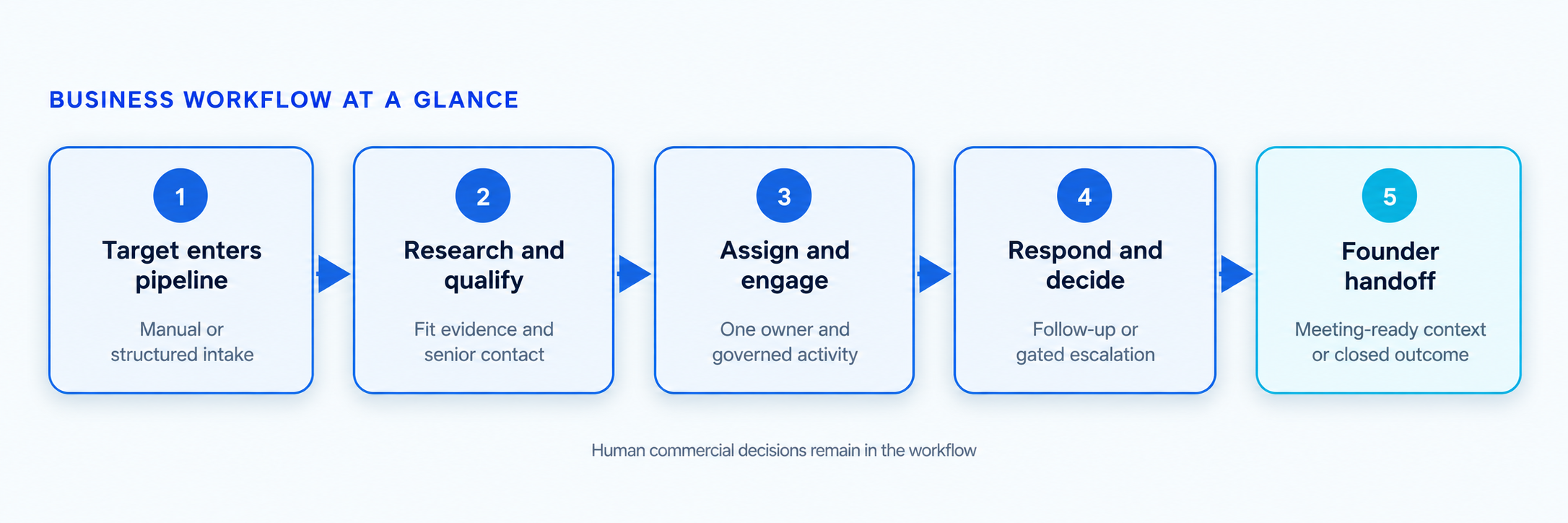
The workflow connects commercial activity without automating commercial judgment
Evidence basis The implementation demonstrates workflow capabilities, but the repository contains no measured business outcome data.
BEFORE STATE
The business workflow
A target organization enters the pipeline, moves to a relevant frontline queue, and receives an owner. The operator researches fit and a senior contact, engages the prospect through an approved external channel, records the response and next action, escalates substantive interest, and prepares complete meeting context for a founder. Managers monitor ownership, stage, priorities, and exceptions; administrators govern access.
The problem with the traditional workflow
The organization documented a prior pattern of disconnected spreadsheets and personal notes. That fragmented the same process across people and channels, forcing managers to reconstruct ownership, follow-up status, and context when an interested prospect required attention.
- Target data was copied into separate working trackers.
- Research evidence and contact details could remain in personal notes.
- Assignment and follow-up depended on direct coordination and reminders.
- Duplicate contact and parallel records were harder to prevent.
- Founder escalation could arrive without complete interest or meeting context.
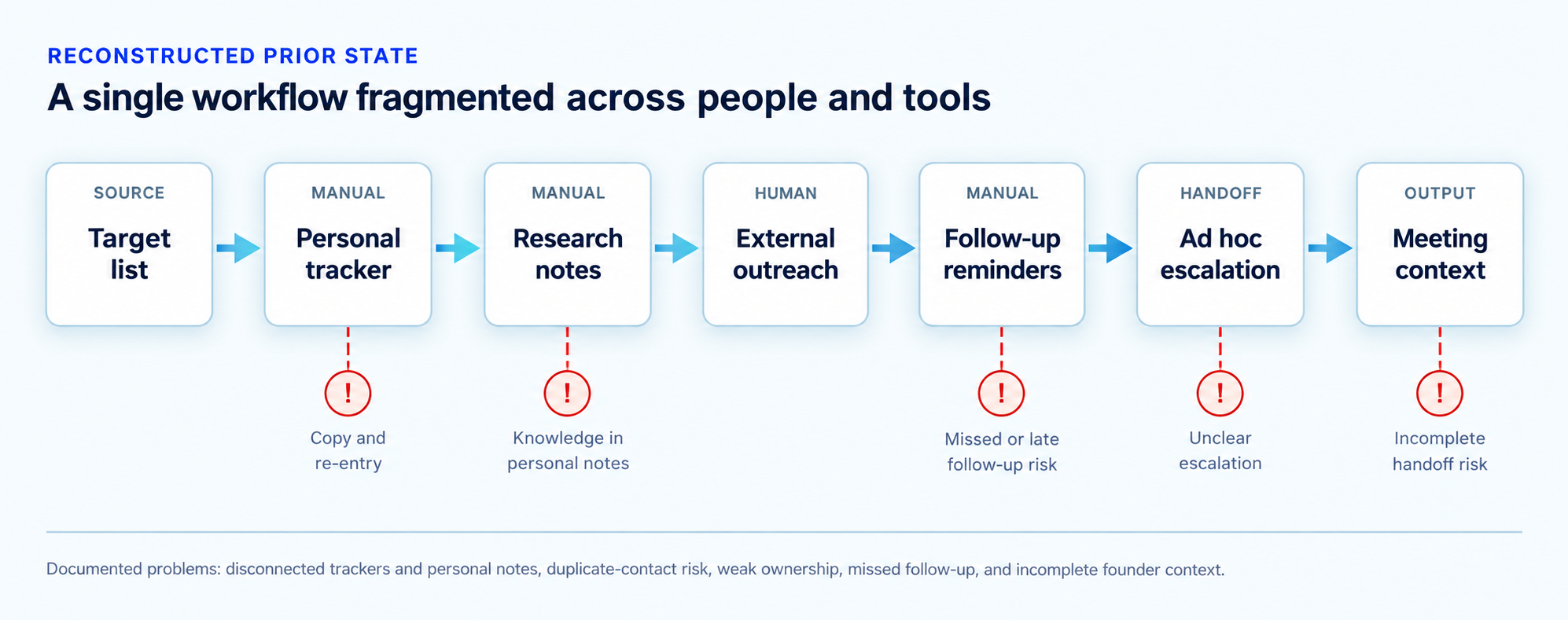
The documented problems are shown in red; the exact historical sequence is a conservative reconstruction
REDESIGNED WORKFLOW
The redesigned workflow
Controlled intake places each target in a role queue and gives it a stable organization identity. One operator claims or receives the workstream record. Required qualification and contact evidence must be present before outreach. The application then maintains activity order, workflow stage, response state, and one dated next action. Interest and founder questions move through structured fields, and a scheduled meeting requires complete logistics.
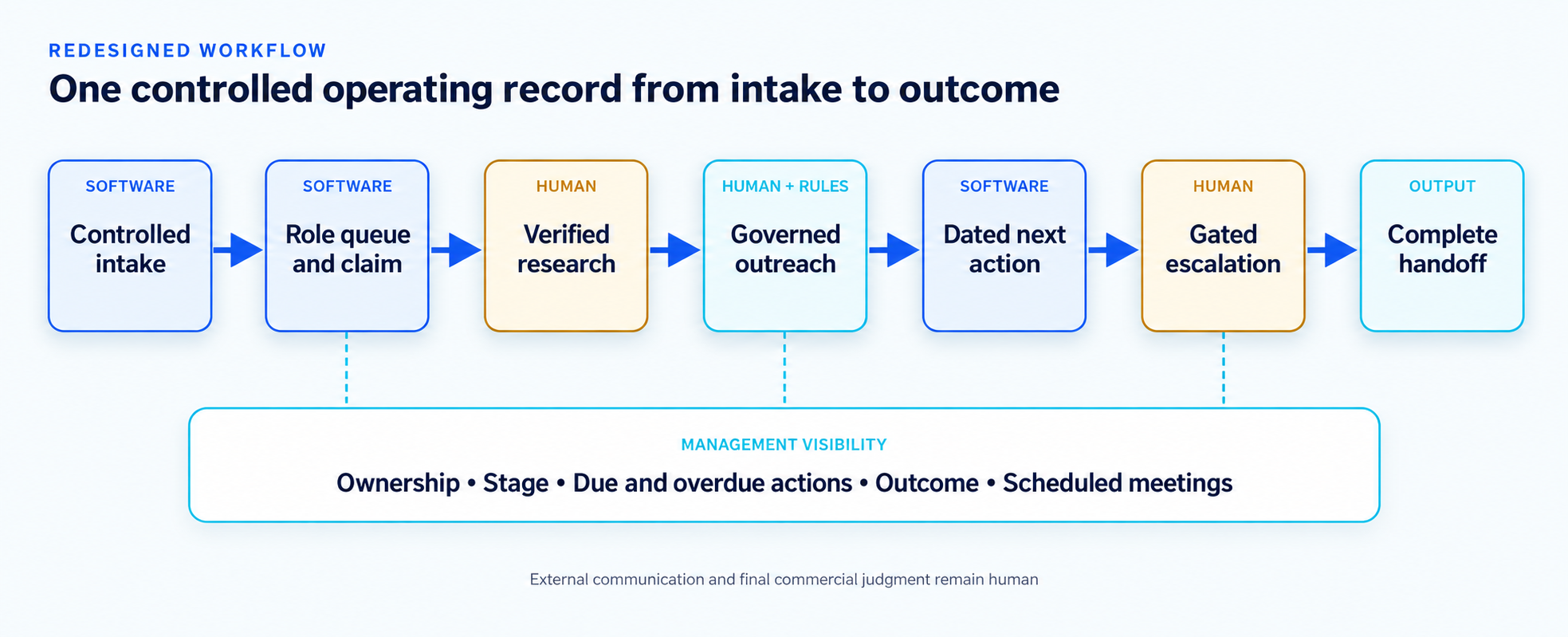
Deterministic controls reduce coordination gaps while outreach and escalation judgment remain human
What the application does
Controls intake and ownership
Validates imported records, routes role queues, and prevents simultaneous claims.
Standardizes qualification
Requires fit evidence, a senior contact, and a usable channel before outreach.
Governs outreach history
Enforces channel prerequisites, actual dates, ordered activity, and a bounded trail.
Keeps state current
Synchronizes stage when activity, response, or outcome changes.
Structures escalation and handoff
Captures verified interest, questions, escalation notes, and meeting details.
Creates visibility and integration
Provides priority views, scoped exports, revocable access, and update audits.
OPERATING MODEL
How the application works
The application is a coordination and control layer. It receives target, ownership, qualification, activity, response, follow-up, and meeting data. It validates and routes that information, maintains a single operational record, and presents the result to the people responsible for the next decision.
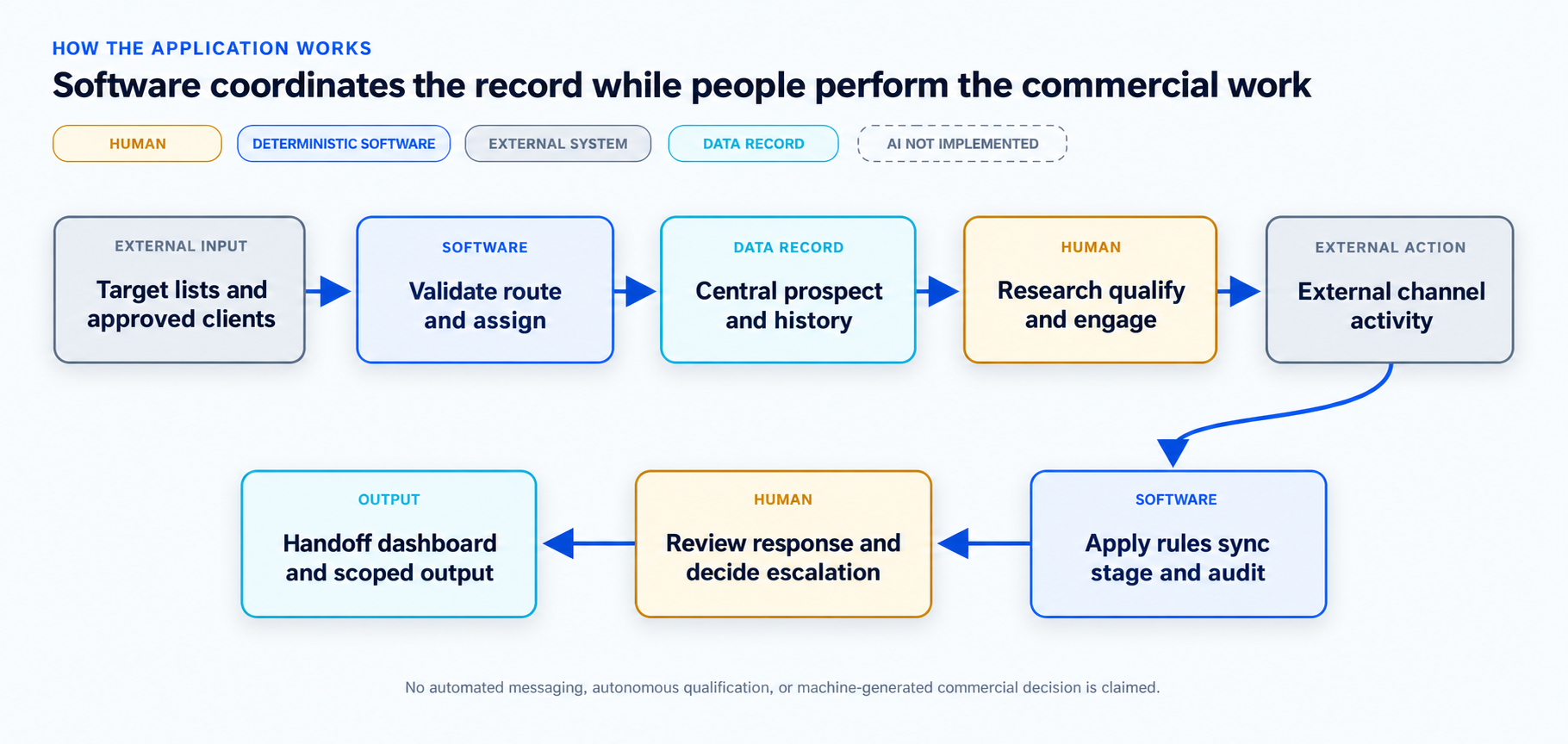
No AI model or automated outbound communication is implemented
Inputs
Manual entry, structured file intake, completed activity, responses, actions, and meeting data.
Deterministic processing
Validation, duplicate checks, locking, sequence assignment, stage synchronization, and rollback protection.
Orchestration
Role scope coordinates queues, permissions, workflow progression, and exception access.
Actions and outputs
Record updates, activity history, change audits, role-scoped exports, dashboards, and APIs.
AI
No model, prompt, inference call, or machine-learning decision stage is present.
Human control
People qualify, communicate, interpret responses, approve escalation, and make commercial decisions.
BUSINESS VALUE
What changed
The evidence supports capability and enablement claims, not quantified outcomes. No measured evidence was found for time saved, conversion, revenue, cost, productivity, error reduction, or ROI.
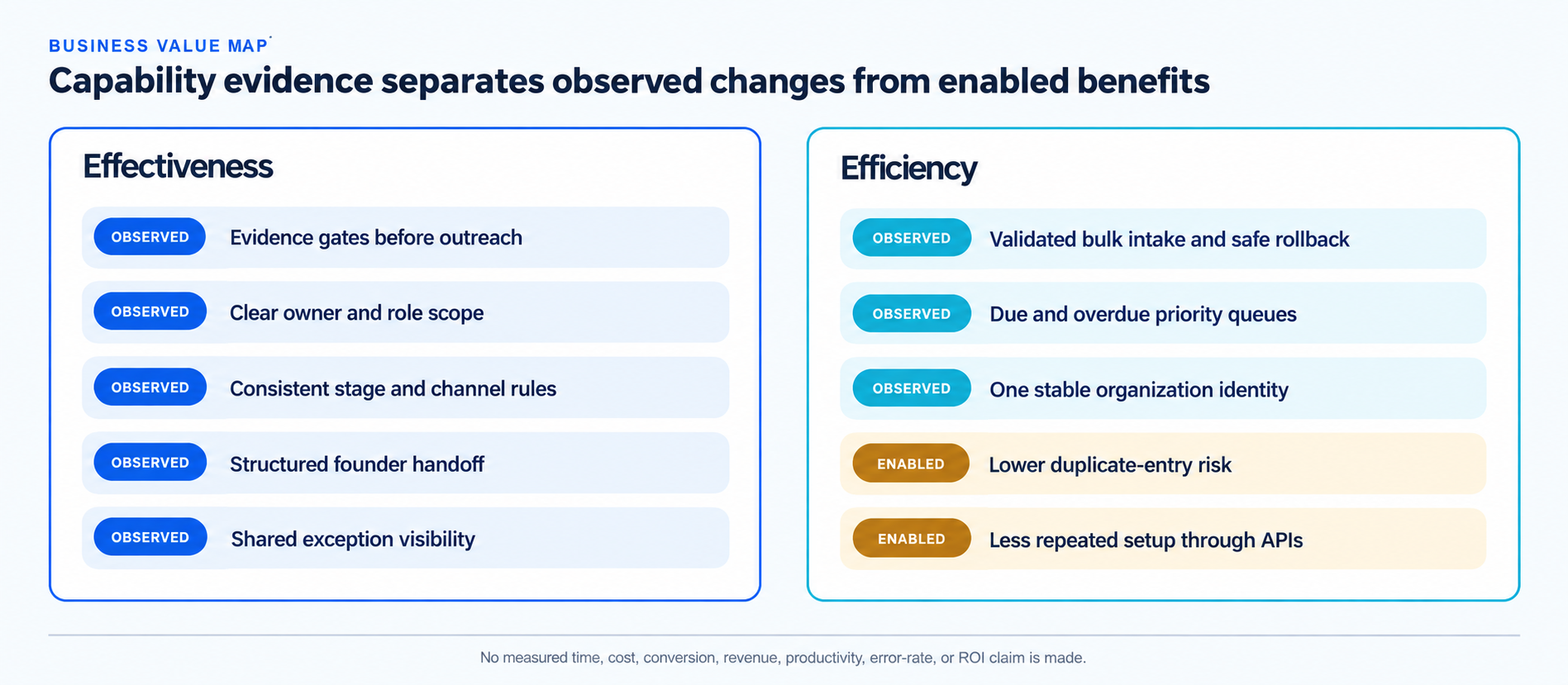
Observed means implemented capability; enabled means a supported benefit that has not been measured
Observed effectiveness
Evidence gates, clear ownership, consistent rules, structured founder handoff, and shared exception visibility.
Observed efficiency
Validated bulk intake, due and overdue queues, stable organization identity, and reusable integration points.
Enabled effectiveness
More complete handoff context and stronger continuity when responsibilities change.
Enabled efficiency
Lower duplicate-entry risk, less manual priority reconstruction, and less repeated setup.
Control remains explicit
The application can validate, route, lock, sequence, synchronize, audit, and surface exceptions. It cannot decide strategic fit, compose or send outreach, interpret commercial intent autonomously, approve founder involvement, or make a commercial commitment.
REUSABILITY
A reusable operating pattern
Common pattern
Many growing organizations run one cross-functional process through separate lists, inboxes, direct messages, and individual memory. The operating gap is the absence of one workflow that makes intake, ownership, required evidence, next action, exception handling, and management visibility explicit.
Applicable functions
Sales development, partnerships, account management, professional services, recruitment, and customer success.
Applicable organizations
Growing or distributed teams with multiple channels, complex handoffs, and constrained management capacity.
Reusable design patterns
Role queues, atomic claiming, stable identity, evidence gates, state synchronization, escalation, and due-date views.
Reusable control patterns
Validated bulk intake, protected rollback, role-scoped integration, audit records, and access administration.
Customization required
Each organization would need its own target criteria, roles, workstreams, channel rules, stage definitions, approval authorities, data sources, integration contracts, terminology, measures, and compliance controls. AI should be added only when a specific task has suitable data, review controls, and a defined risk boundary; it is not part of this implementation.
What this case demonstrates
The organization redesigned an end-to-end business workflow and built software around the improved operating model. The application converts a fragmented prospect-to-meeting process into a controlled sequence with explicit ownership, evidence gates, structured handoff, and visible exceptions. It automates deterministic coordination while leaving qualification, communication, escalation judgment, and commercial decisions with people.
Human decision boundary
- Frontline operators verify qualification and conduct external outreach.
- Managers assign work and resolve exceptions.
- Founders answer substantive questions and make commercial decisions.
- Administrators control access and preserve accountability.
ANONYMIZED WORKFLOW TRANSFORMATION CASE STUDY