EXECUTIVE WORKFLOW TRANSFORMATION CASE STUDY
Connecting Prospecting to Collections and Cash Flow
An anonymized workflow transformation case study
BUSINESS CHALLENGE
A growing specialist B2B services company needed several functions to move the same opportunity from prospecting through meetings, sales, contracting, invoicing and collection. The coordination points made status easy to lose and management follow-up dependent on manual checking.
OBJECTIVE
Create one controlled workflow that gives each role a clear next action, moves information forward at defined events, surfaces exceptions and connects commercial activity to cash visibility.
SOLUTION
The organization built a role-based web application around the full lead-to-cash path. It combines prospect approval, call evidence, meeting coordination, sales progression, contract installments, collection tracking and a rolling cash view.
EVIDENCE BASIS
The evidence reviewed confirms implemented capabilities and control logic. It includes no verified before-and-after KPI baseline, so this case study does not claim time savings, ROI, revenue lift or error reduction.
VALUE CREATED
• One role-based workflow across lead generation, sales, contracts, finance and business management
• Automatic transitions and notifications at defined business events
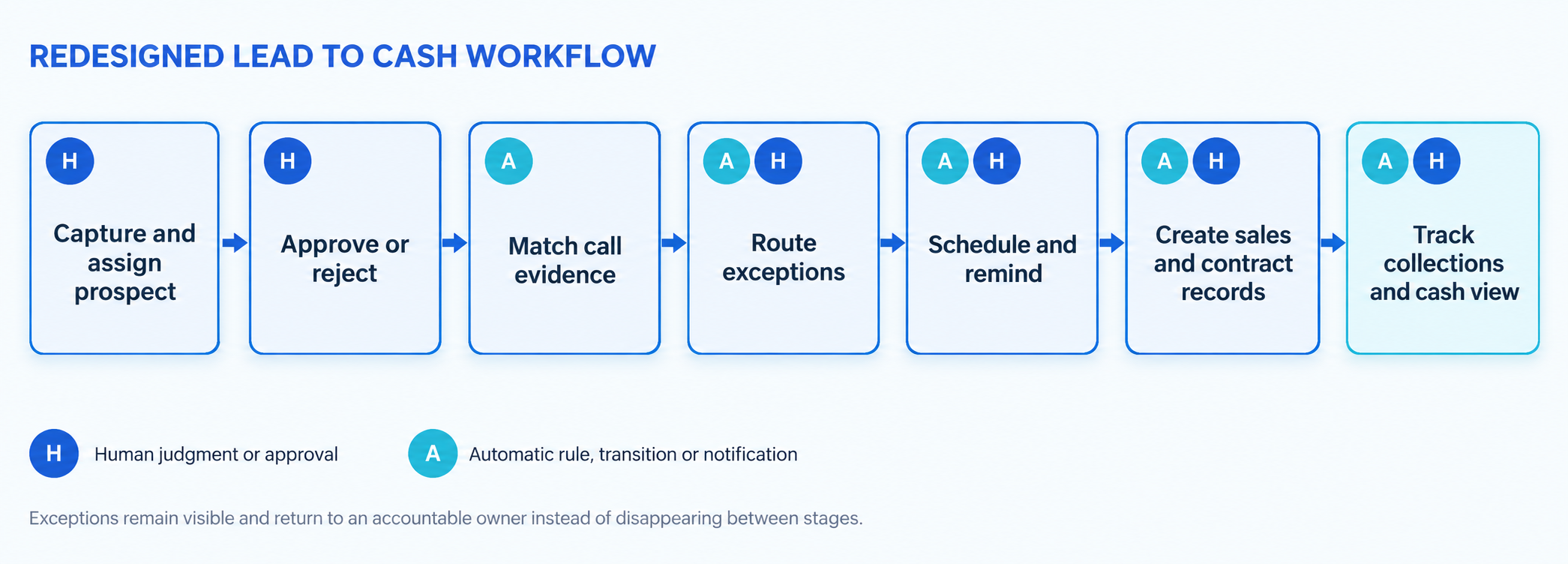
• Visible exception queues for invalid data, repeated no-answer, missed reminders and overdue dates
• Management views spanning outreach activity, pipeline, collections, order book and 12-week cash projection
01 BUSINESS CONTEXT
The business workflow
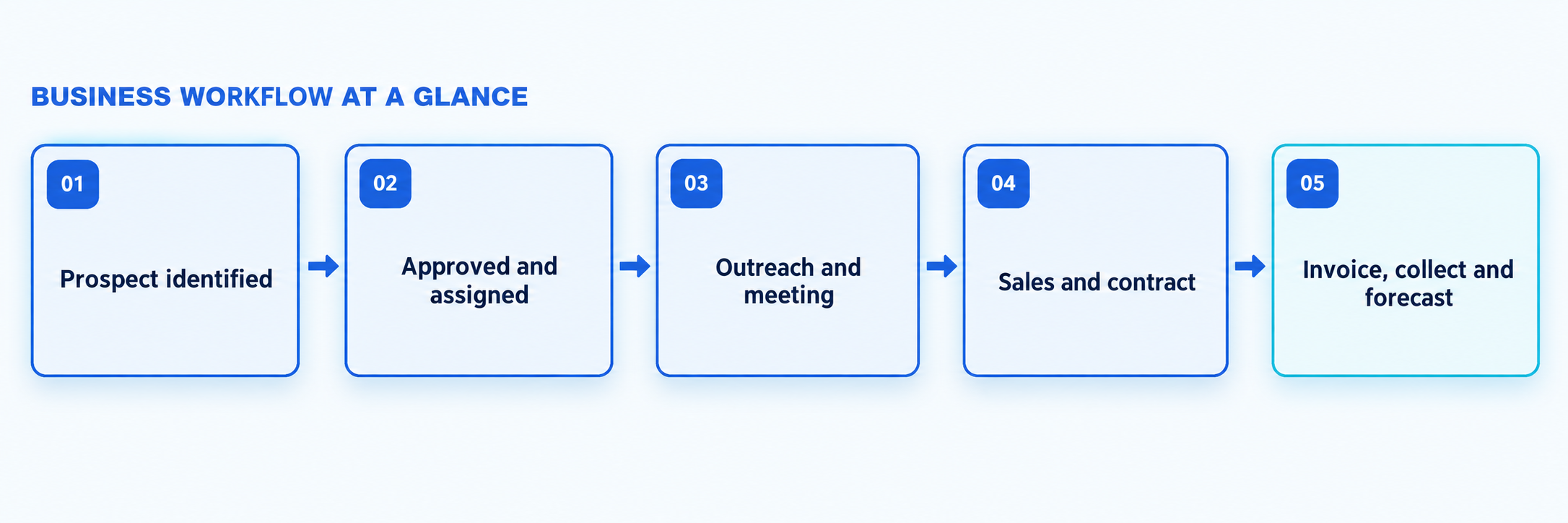
The workflow starts when a target account or contact is identified and assigned for outreach. A supervisor decides whether the prospect should enter the calling queue. Lead generation staff then record the commercial outcome, coordinate a meeting and hand a successful conversation to sales. Sales develops the opportunity, and a signed or projected deal moves into contract, invoice and collection planning. Finance and business management use those dates alongside accounting exports to maintain a rolling cash outlook.
TRIGGER
A prospect is identified or a sales conversation is opened directly.
PARTICIPANTS
Lead generation, supervisor, sales, finance, business management and marketing.
BUSINESS OUTCOME
A controlled path from outreach to collection and cash visibility.
The problem with the traditional workflow
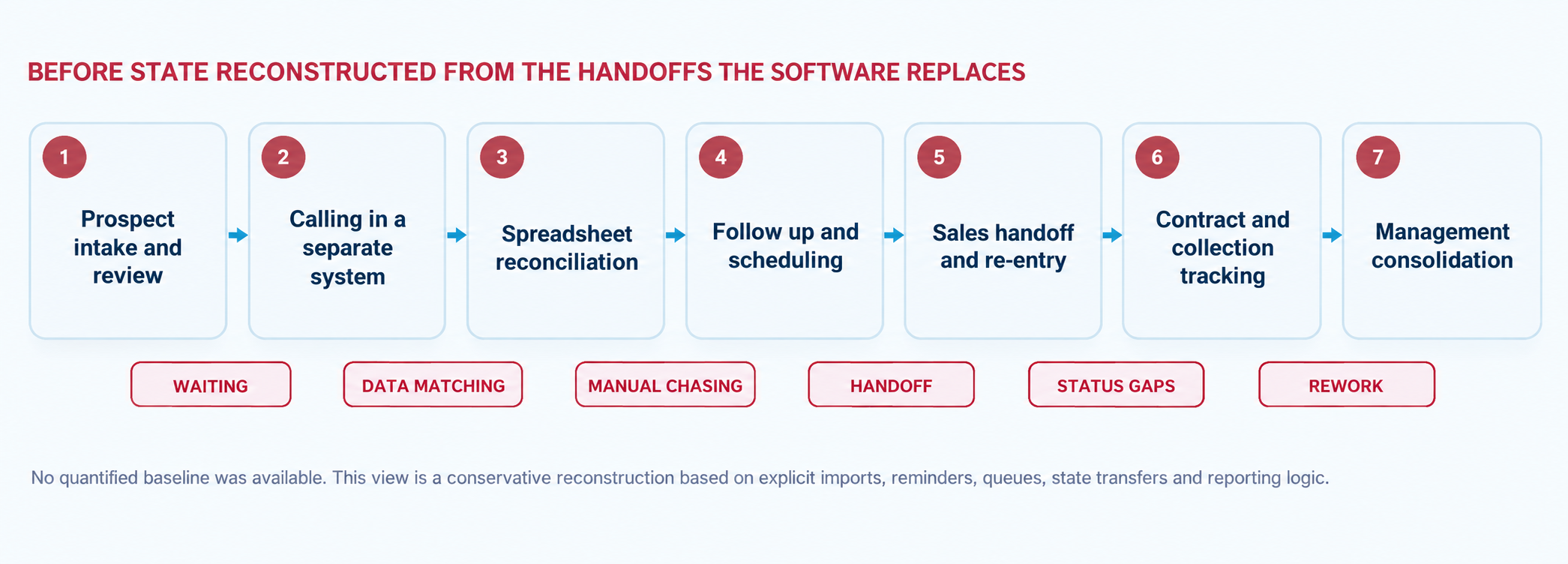
The application design indicates the operating friction it was built to remove. Call evidence arrived through external spreadsheets; meeting coordination crossed email, calendar and manual messaging; and responsibility moved between teams as the record changed from prospect to opportunity, contract and cash item.
- Repeated re-entry when the same account moved between lead generation, sales and finance
- Manual monitoring of call attempts, follow-up dates, reminders, invoice dates and overdue items
- Unclear ownership when contact data failed, a meeting did not happen or a date became stale
- Separate operational views that required management consolidation to understand the full path
02 OPERATING REDESIGN
The redesigned workflow
The redesigned process uses a shared record and explicit status transitions. Human decisions determine whether to approve a prospect, how to handle an exception, whether a meeting happened, how an opportunity should progress and when commercial or cash assumptions should change. Software performs the repeatable work around those decisions: matching records, moving states, creating downstream records, scheduling communications, calculating views and presenting queues.
What the application does
CONTROLLED INTAKE
Captures prospects, assignments and supervisor approval before outreach.
EVIDENCE AND EXCEPTIONS
Matches call exports to staff and prospects, then routes invalid or repeatedly unanswered records.
MEETING COORDINATION
Creates invitations, calendar files, scheduled reminders and proof-based manual messaging steps.
COMMERCIAL HANDOFF
Creates a sales record when a meeting is marked as held and carries contact context forward.
CONTRACT AND COLLECTION
Creates contract records from signed opportunities and tracks installments, dates and receipts.
EXECUTIVE VISIBILITY
Aggregates activity, missed actions, pipeline status, pending collections, order book and cash projection.
03 APPLICATION MODEL
How the application works
INPUTS
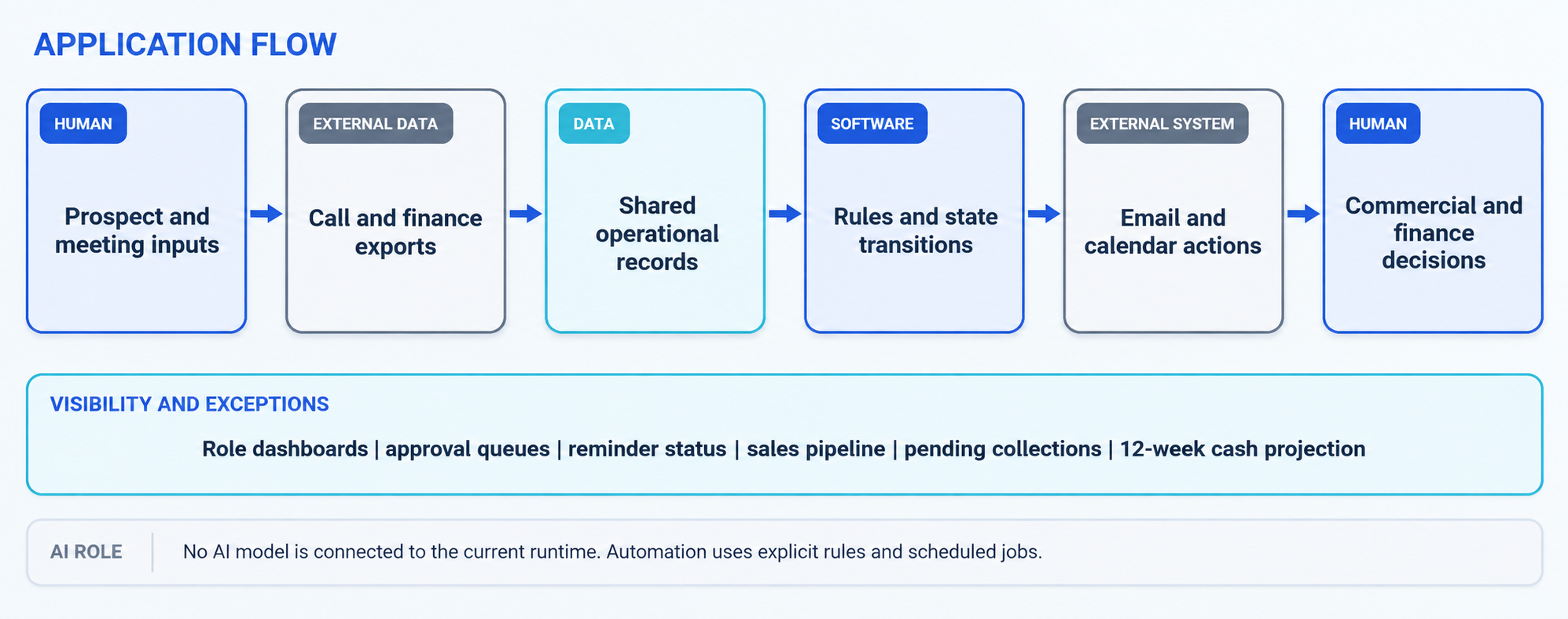
Prospect and contact details, assignments, call spreadsheets, meeting dates, sales notes, proposals, contract installments, collection updates and accounting exports.
PROCESSING
The application normalizes and matches data, validates required fields, applies status rules and calculates operational and financial summaries.
ORCHESTRATION
Saved business events and scheduled commands coordinate meeting communications, downstream record creation, invoice due alerts and recurring reports.
ACTIONS
It sends email and calendar communications, creates linked records, updates queues and generates role-specific dashboards.
HUMAN CONTROL
People approve prospects, select call outcomes, confirm meeting results, manage sales stages, set contract terms, revise dates and record collections.
VISIBILITY
Managers can monitor staff activity, import quality, reminders, pipeline, contracts, pending collections, blockers and a rolling cash view.
AI in the current release No AI model, prompt or inference service is connected to the runtime. Current automation is deterministic and auditable; judgment remains with accountable users.
04 BUSINESS VALUE
What changed
The strongest supported value is structural. The implementation joins previously separate coordination points into a governed operating path and makes the current state visible. The diagram distinguishes capabilities observed directly in the software from outcomes the design enables.
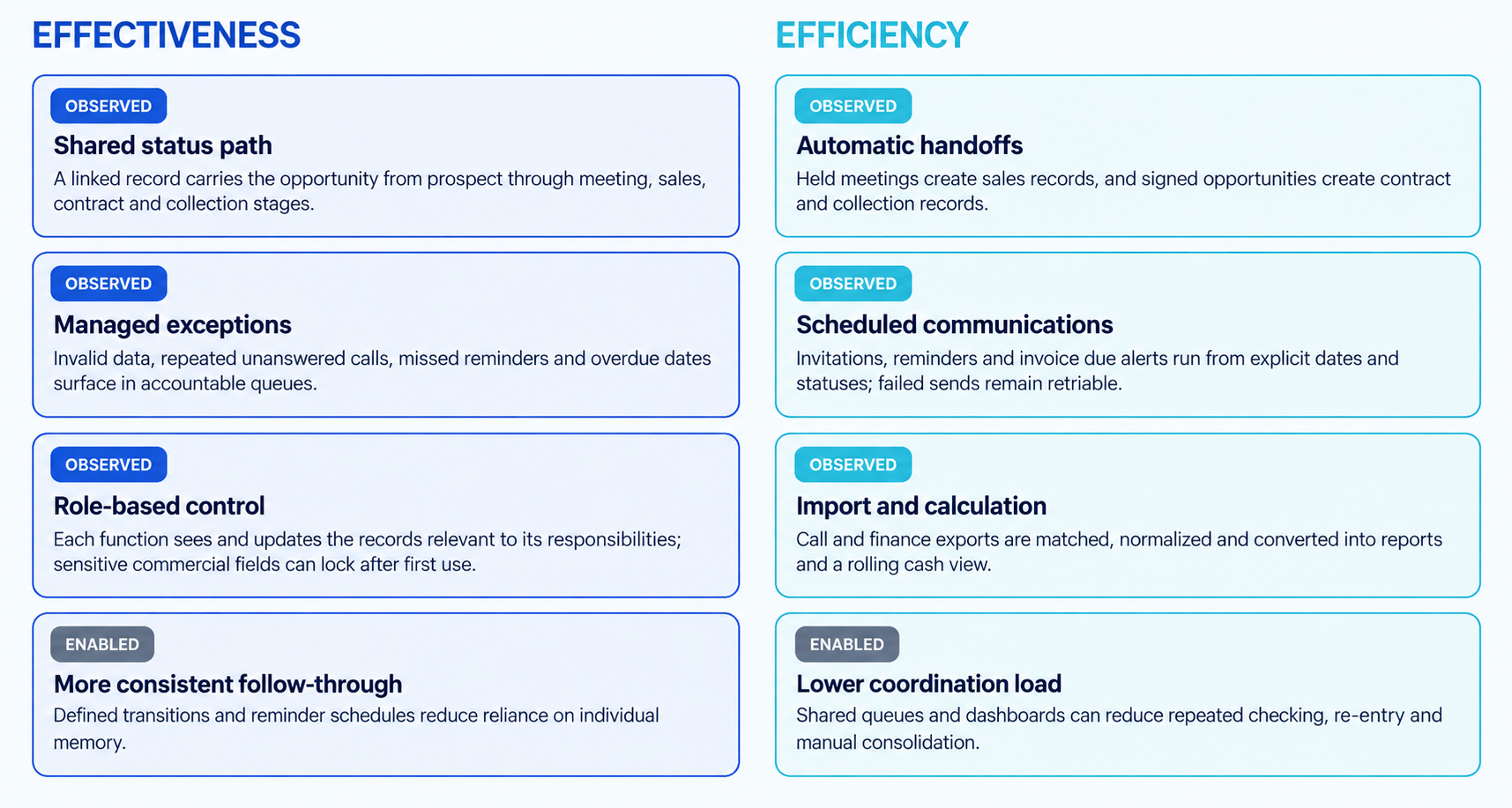
Evidence status No measured operating benefit is claimed. The evidence base includes implemented workflow logic, automated tests and interface behavior, but no verified baseline or post-implementation KPI series.
Human control The system automates repeatable coordination while people retain approval, commercial, exception and financial decisions. This preserves accountability where context and risk matter.
05 REUSABILITY
A reusable operating pattern
This pattern applies wherever a revenue opportunity crosses functional boundaries before it becomes cash. It is especially relevant to growing or distributed services firms that use separate calling, email, calendar, accounting or spreadsheet tools but need a shared operational record.
What can be reused and what must change
Reusable operating pattern | What changes by organization |
|---|---|
A state-based opportunity lifecycle | Stage definitions, terminology and exception rules |
Role scoped workspaces and approvals | Roles, access rights and approval authority |
Event- and time-based reminders | Thresholds, communication channels and service levels |
Cross functional handoff logic | Integrations, source data and downstream systems |
Management views built from transaction records | Metrics, reporting horizon and governance requirements |
Where the pattern fits
Applicable functions include sales, marketing, finance, operations, account management and executive management. The pattern fits work where ownership changes, the next action depends on status or time, and managers need to see stalled work and future commitments.
Technical foundation
The implementation is an authenticated role-based web application with a relational data model, spreadsheet import, email and calendar integration, scheduled jobs and cloud deployment. It can connect existing source systems instead of replacing them. AI could support specific unstructured tasks later, but it is not required for this workflow.
What this case demonstrates
The value came from redesigning the lead-to-cash workflow around explicit ownership, controlled handoffs, timed actions and visible exceptions. Purpose-built software made that model executable and created a traceable foundation for consistent follow-through and management visibility.
Anonymized workflow transformation case study |