WORKFLOW TRANSFORMATION
EXECUTIVE CASE STUDY
Connecting Projects Talent and Cash Collection in One Workflow
An anonymized account of a purpose-built operating system for a project-based services organization
Business challenge
A growing services organization had to coordinate client engagements, staffing, contracting, recurring billing, approvals, payables and collections across several functions. Every handoff depended on accurate dates, documents, ownership and status.
Objective
Create one controlled workflow from engagement setup through financial settlement. Routine scheduling, document generation, reminders and status updates should run consistently, while managers retain authority over hiring, approvals, client communication and exceptions.
Solution
A role-based operations application now links each engagement to recruitment, candidates, contracts, billing rules, invoices, supporting documents, approvals, payments and leave.
Value created
- One operating record connects delivery, talent and finance
- Repeatable rules replace calendar watching for scheduled invoice work
- Approval authority remains explicit at financial and account checkpoints
- Exceptions retain context and a governed path back to the right owner
- Shared registers expose invoice, balance, evidence and payment status
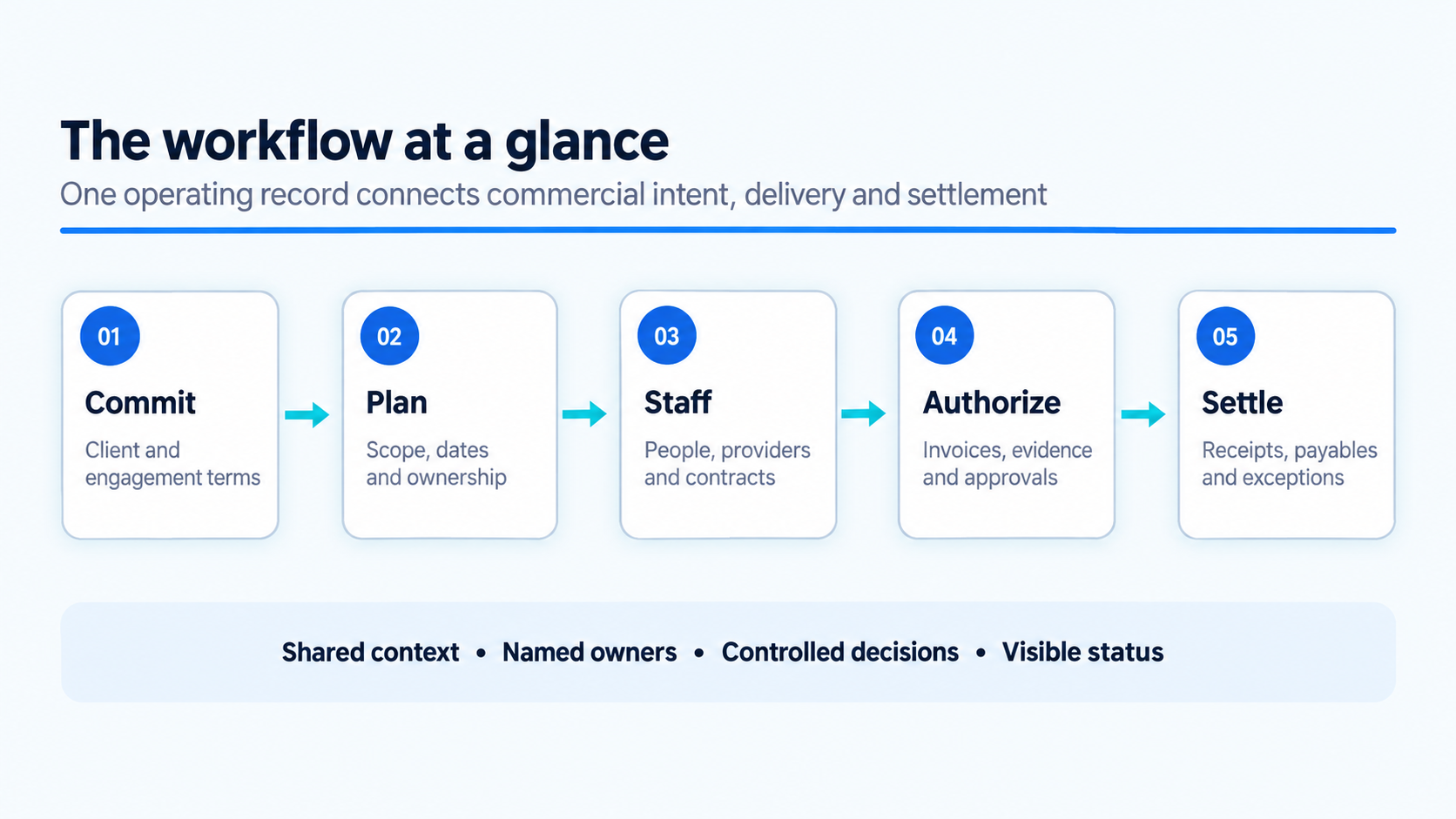
FROM COMMERCIAL COMMITMENT TO SETTLEMENT
The business workflow
Operations records the client, agreement, engagement, responsible account owner, dates and commercial terms. That record can create staffing requirements. HR manages candidates and interviews; interviewers submit scorecards; approved hires receive contract and invoice terms. Operations also defines client and provider billing schedules.
Dates and rules trigger invoice work. Client billing items become invoices for review. Candidates and providers receive controlled requests to submit documents. Finance and the account owner review the relevant transactions, then record receipts and payments.
Participants and responsibility
- Operations — engagement setup, commercial schedules and provider records
- HR and interviewers — pipeline, evidence, contracts and leave administration
- Account owners — client-facing and assigned provider decisions
- Finance — authorization, client billing, receipts and payables
- External payees — controlled submission of invoice evidence
- Administrators — identity, access and production operation
The traditional pattern
The repository does not preserve a measured account of the prior process. This before-state is therefore a conservative reconstruction of the fragmented workflow the application was designed to replace.
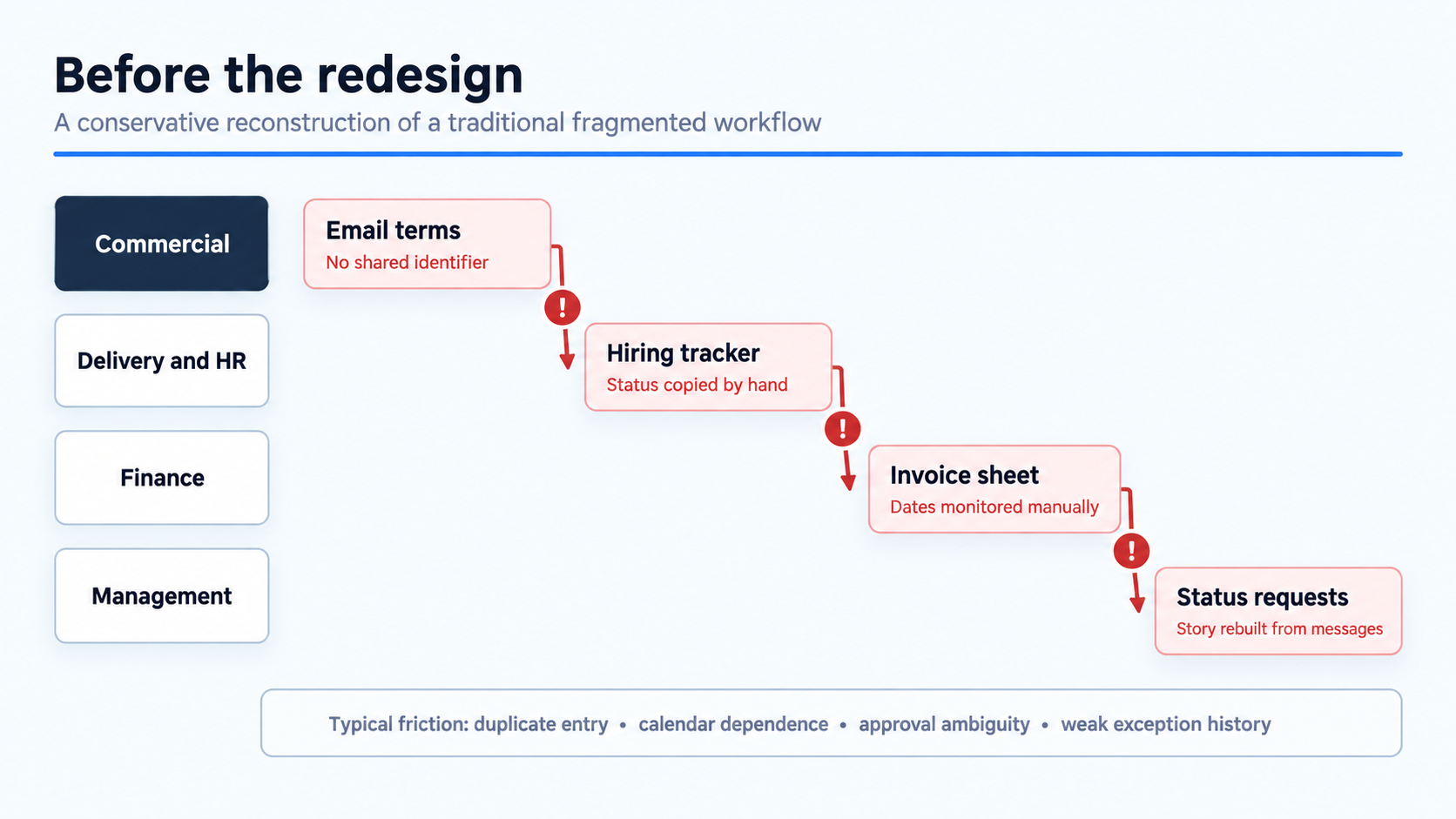
ONE CONTEXT WITH ROLE-SPECIFIC ACTION
The redesigned workflow
Recruitment and billing now branch from the same engagement context. Every stage writes back to a shared operating record, preserving the item, amount, due date, owner, document and status needed by the next function.
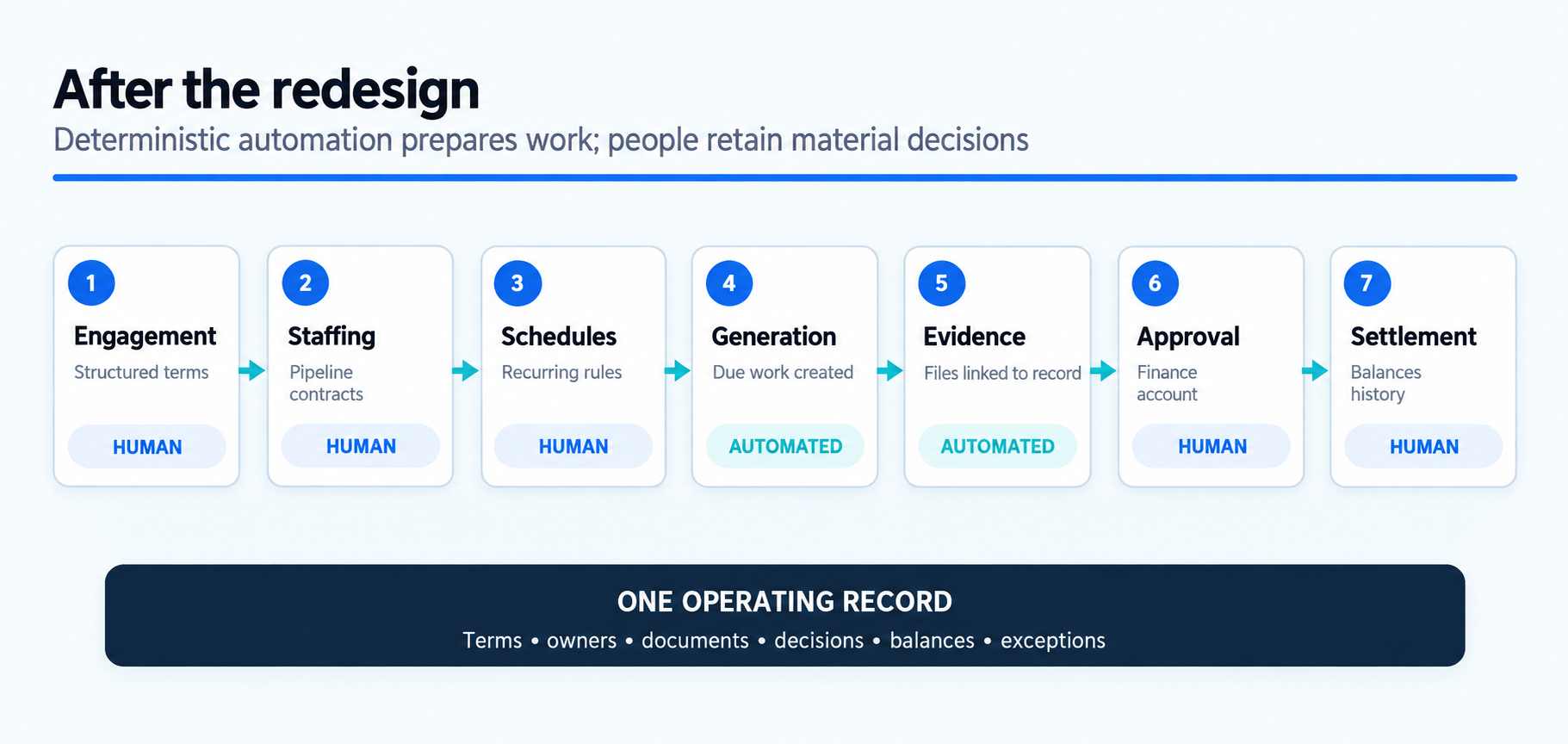
What the application does
- Structures commercial intake around clients, engagements, ownership, dates and billing terms
- Connects staffing, candidate stages, interviews, contracts, providers and leave
- Schedules one-time and recurring receivables and payables, including historical records
- Stores generated invoices and uploaded supporting evidence with each transaction
- Routes Finance and account approvals, clarification, correction and resubmission
- Tracks balances, partial settlement, reversals, cancellations and payment history
- Surfaces upcoming work, pending decisions and exceptions through role-specific queues
AUTOMATION WITH ACCOUNTABLE CONTROL
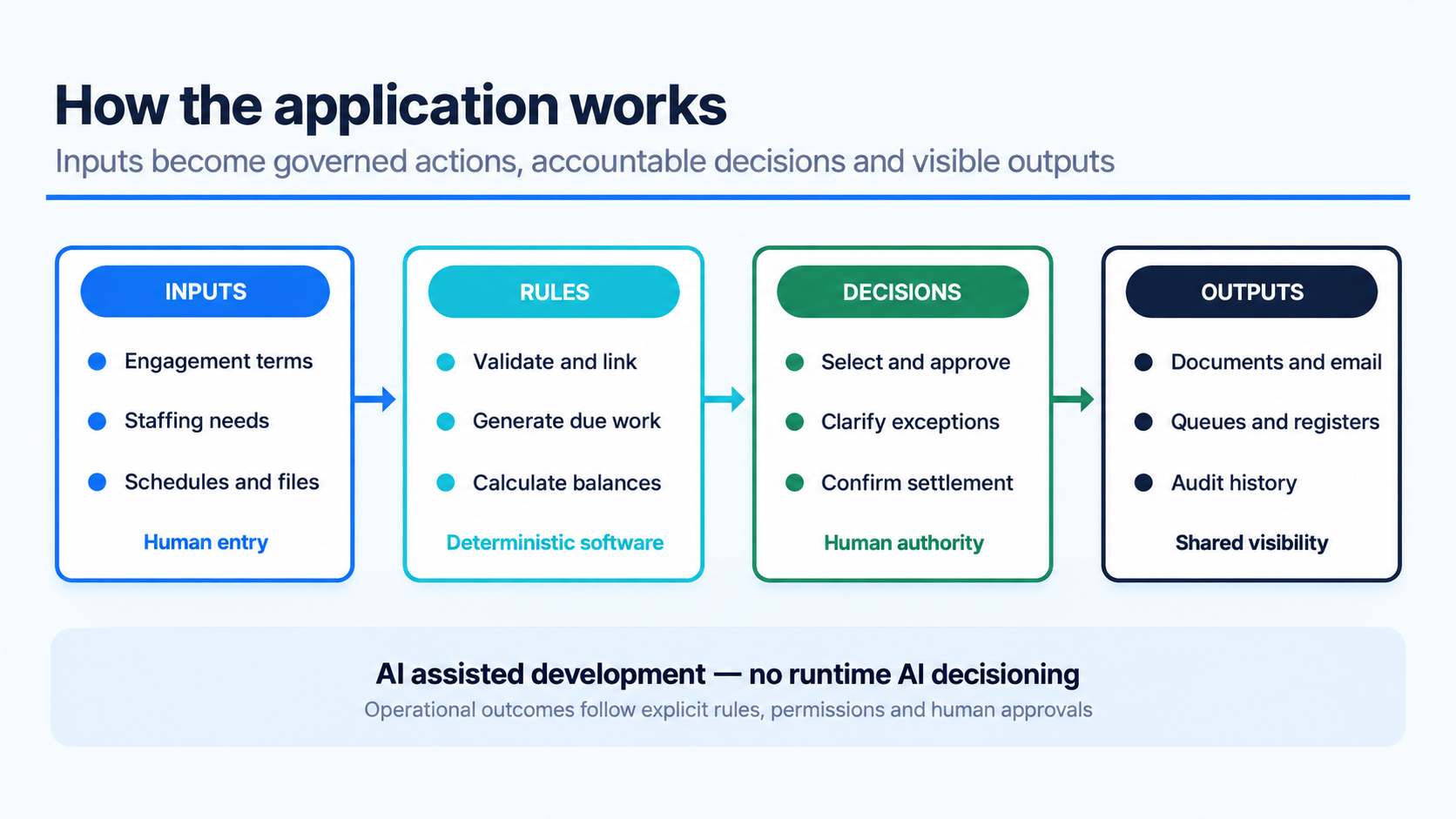
How the application works
Inputs
Users enter engagement terms, staffing needs, candidate evidence, contracts, schedules, payment details and leave requests. Candidates and providers contribute invoice files through single-use links.
Processing and orchestration
Deterministic rules validate roles, dates, amounts and status transitions. A daily scheduled process creates due work, produces invoice documents, calculates balances and routes notifications.
AI
The production application does not call a language model or delegate operational judgment to AI. AI assisted software development; runtime execution relies on explicit business logic and human decisions.
Human control
People remain responsible for selection, contract terms, financial and account approval, client communication, payment confirmation and exception handling.
Outputs and visibility
The system produces invoice documents, upload requests, approval messages, role queues, registers, payment histories, leave records, notifications and activity logs.
EFFECTIVENESS AND EFFICIENCY
What changed
Effectiveness
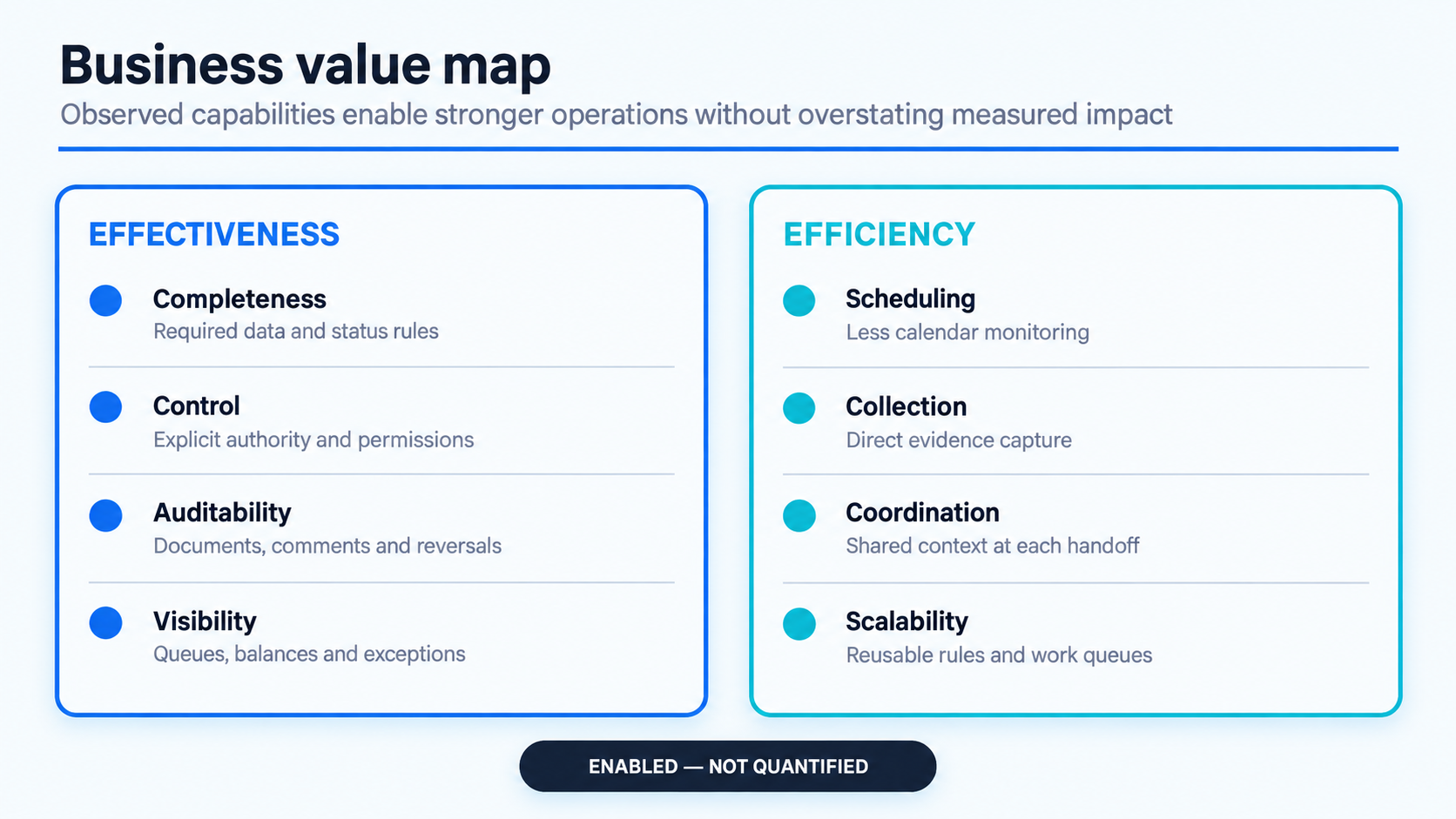
Required fields and status rules improve completeness. Permissions make authority explicit. Documents, comments and reversals stay with the transaction, strengthening auditability. Common registers provide a current view of upcoming work, approvals, balances and exceptions.
Efficiency
Scheduled generation reduces calendar monitoring. Controlled links collect evidence directly into the correct record. Shared data reduces reconstruction of client, engagement and payee context. Historical backfill brings legacy transactions into the same register without replaying current notifications.
Evidence boundary
These are observed capabilities and enabled benefits. The repository contains no time study, cost baseline or before-and-after business metrics, so this case study makes no quantified savings, ROI or error-reduction claim.
LESSONS FOR PROJECT-BASED BUSINESSES
A reusable operating pattern
Commercial commitments create delivery work. Delivery requires people or providers. Those commitments create receivables, payables and management obligations. When each function manages only its own tracker, the connection between the original engagement and later financial events becomes fragile.
The reusable model
- Use a shared engagement record with role-specific work surfaces
- Turn business events and dates into scheduled actions
- Let deterministic rules prepare repeatable work
- Give external contributors controlled intake paths
- Keep material decisions with accountable people
- Return exceptions to named owners with full context
- Expose both operational progress and financial settlement
Where it applies
This pattern fits growing professional-services firms, distributed delivery businesses, staffing and consulting organizations, and multi-function companies whose transaction volume is outgrowing spreadsheet-led coordination.
What is reusable and what must be configured
The workflow model, approval states, audit pattern, schedule engine, secure intake design and management registers are reusable. Each organization must configure terminology, commercial rules, approval limits, integrations, compliance controls, metrics and user experience.
What this case demonstrates
The value comes from redesigning the complete workflow before automating it. Purpose-built software makes the improved sequence repeatable: routine work is scheduled, each handoff carries context, exceptions remain visible, and people retain authority over hiring, financial approval and client communication.
AI can accelerate how the software is designed and built. Trust in the operating workflow still comes from explicit rules, controlled access and accountable human decisions.
ANONYMIZED CASE STUDY •