EXECUTIVE WORKFLOW TRANSFORMATION CASE STUDY
Connecting Attendance and Leave to a Controlled Payroll Close
An anonymized workflow-transformation case study
A monthly payroll close depends on decisions made throughout the month. This application connects those decisions to the records used to prepare pay.
BUSINESS CHALLENGE
Attendance, approved leave and payroll preparation cross several owners. When approval evidence and dated records need to be reconciled, a routine close can become a coordination exercise.
OBJECTIVE
Create a traceable path from daily records to reviewed payroll inputs, while preserving authority over leave, attendance exceptions and later corrections.
SOLUTION
A purpose-built application captures attendance and requests, routes human decisions, reuses approved dates, prepares monthly review and calculates exportable payroll records.
VALUE CREATED
Shared attendance and absence inputs.
Named decision owners.
Repeatable payroll calculations.
Separate correction records.
Business workflow at a glance
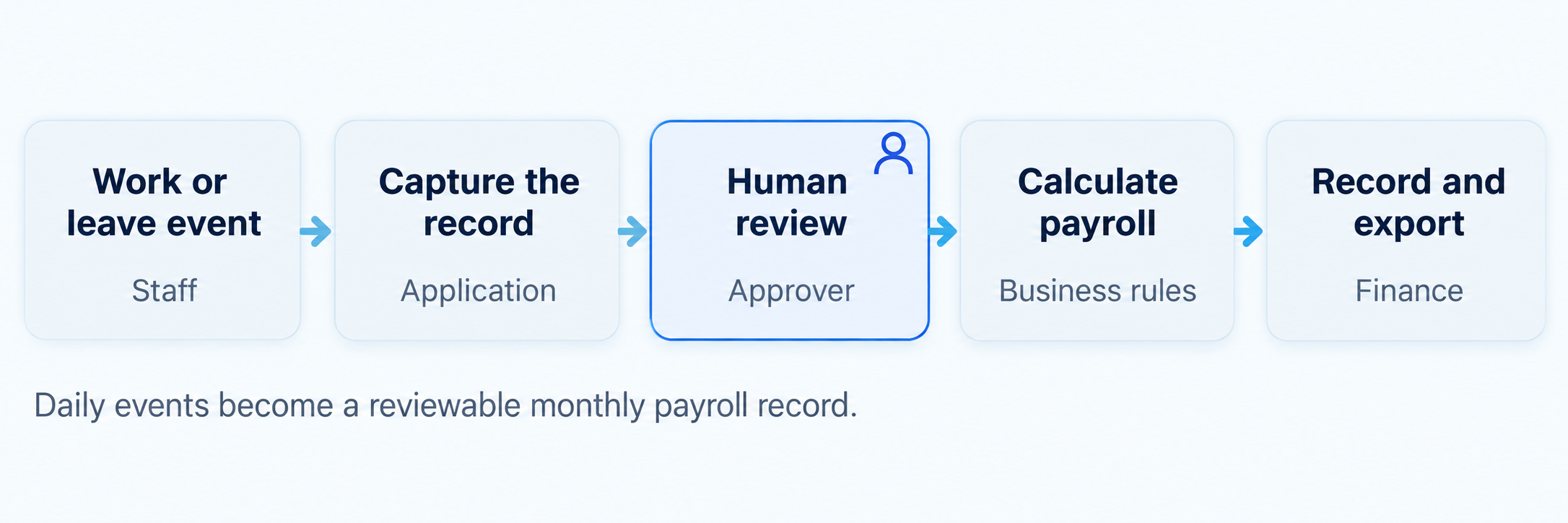
What this case establishes Implemented workflow capabilities and the benefits they enable. No quantified business improvement is claimed.
Scope: payroll preparation and review. Payment execution remains outside the application. AI is not used in the implemented workflow.
EXECUTIVE CASE STUDY / 02
The business workflow
The process starts with a working day, a leave need or a missed attendance entry. Staff provide dated information; managers judge regular leave; a designated central approver decides attendance exceptions. At month-end, managers confirm team information and HR or Finance prepares payroll using employment dates, compensation, holidays and leave rules.
Before-state workflow
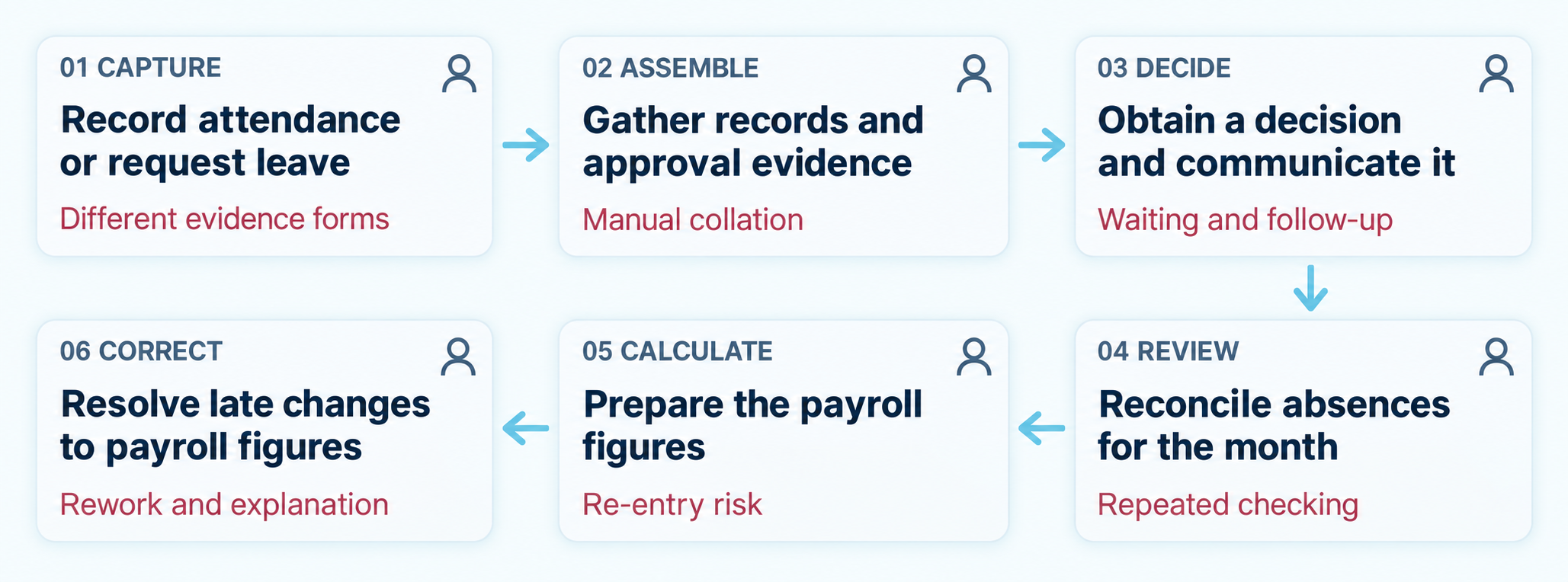
Reconstructed traditional workflow. The person icon marks human responsibility; red labels show inferred friction, not measured historical failures.
The problem with the traditional workflow
Approval evidence must travel
A decision recorded outside the payroll record must reach the person preparing pay.
Ownership must stay clear
Missing or incorrect manager assignments interrupt a request or monthly review.
Dates need reconciliation
Attendance, leave and exceptions must agree without counting the same date twice.
Late changes need explanation
A correction after payroll preparation needs a clear link to the original figures.
What is known Earlier application code allowed manual entry of approved leave; workflow text also refers to email or written approvals. The complete pre-application process, tools, delays and workload are unknown. The broader before-state is an evidence-based reconstruction.
EXECUTIVE CASE STUDY / 03
The redesigned workflow
The redesigned process carries a dated record from submission into payroll preparation. People make the decisions; software transfers the results, applies common rules and shows which reviews remain outstanding. This removes the need for a separate transcription step when a request is approved.
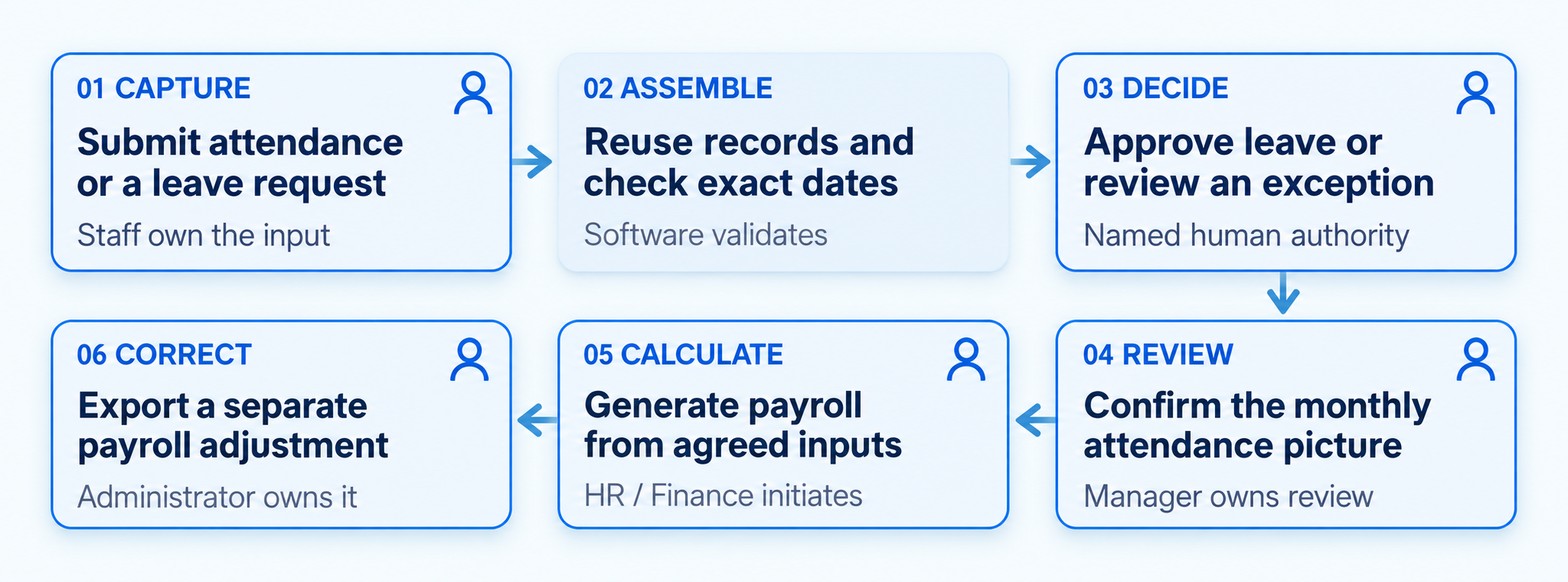
Cobalt outlines and the person icon identify human responsibility. Software checks records, transfers approved dates and performs calculations.
What the application does
Capture the facts
Accept daily work summaries, supporting files, exact leave dates and reasons for exceptions.
Route the decision
Send regular leave to the assigned manager and attendance exceptions to the central approver.
Connect approval to pay
Write the approved absence into the same information set used for payroll calculations.
Prepare the monthly review
Show team availability and approved-day categories, with submitted or pending review status.
Apply the payroll rules
Use employment dates, working days, leave allowances and unpaid absences to calculate amounts.
Preserve a correction path
Export the saved payroll; create a separate adjustment comparison for later payment follow-up.
For the regular previous-month close, missing manager details or approvals block generation. An administrator can override that gate, with a note on the run.
EXECUTIVE CASE STUDY / 04
How the application works
Purpose-built software connects the organization’s particular calendars, approval authorities and correction rules in one process. It joins staff input, recorded policy and role-specific decisions. External services provide account sign-in and email delivery; payroll records and corrections leave as downloadable files.
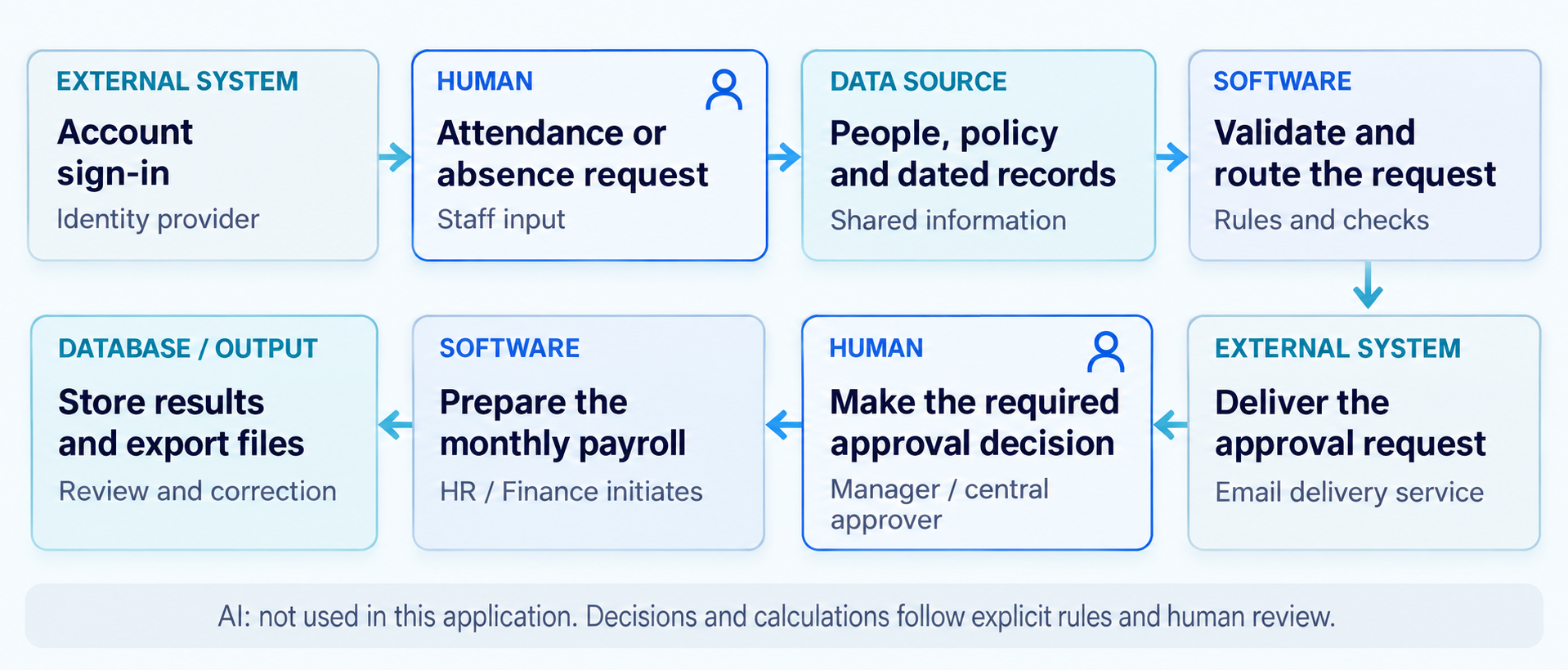
The flow is schematic: approvals happen during the month and again at monthly review. The calculation stage follows those decisions.
INPUTS AND CONTEXT
Identity, reporting lines, employment and contract dates, compensation, leave rules, holidays and daily records.
PROCESSING AND AI
Defined software rules validate dates and apply payroll calculations. No model interprets work summaries or makes pay decisions.
ORCHESTRATION AND ACTIONS
Scheduled jobs request attendance follow-up and monthly review. Human approvals update absence records and trigger outcome emails.
OUTPUTS AND VISIBILITY
Attendance history, approved absences, review status, payroll detail, payroll exports and separate correction comparisons.
Human control and exceptions
Managers decide regular leave; the central approver decides attendance exceptions. HR or Finance initiates payroll, and administrators own overrides and later adjustment uploads. People follow up on unanswered requests and resolve configuration problems. There is no automatic overdue-approval escalation or payment release.
Controls have boundaries: the manager gate applies to the previous-month close; older-month generation follows a different path. Approval records are not shown to freeze the underlying inputs.
EXECUTIVE CASE STUDY / 05
What changed
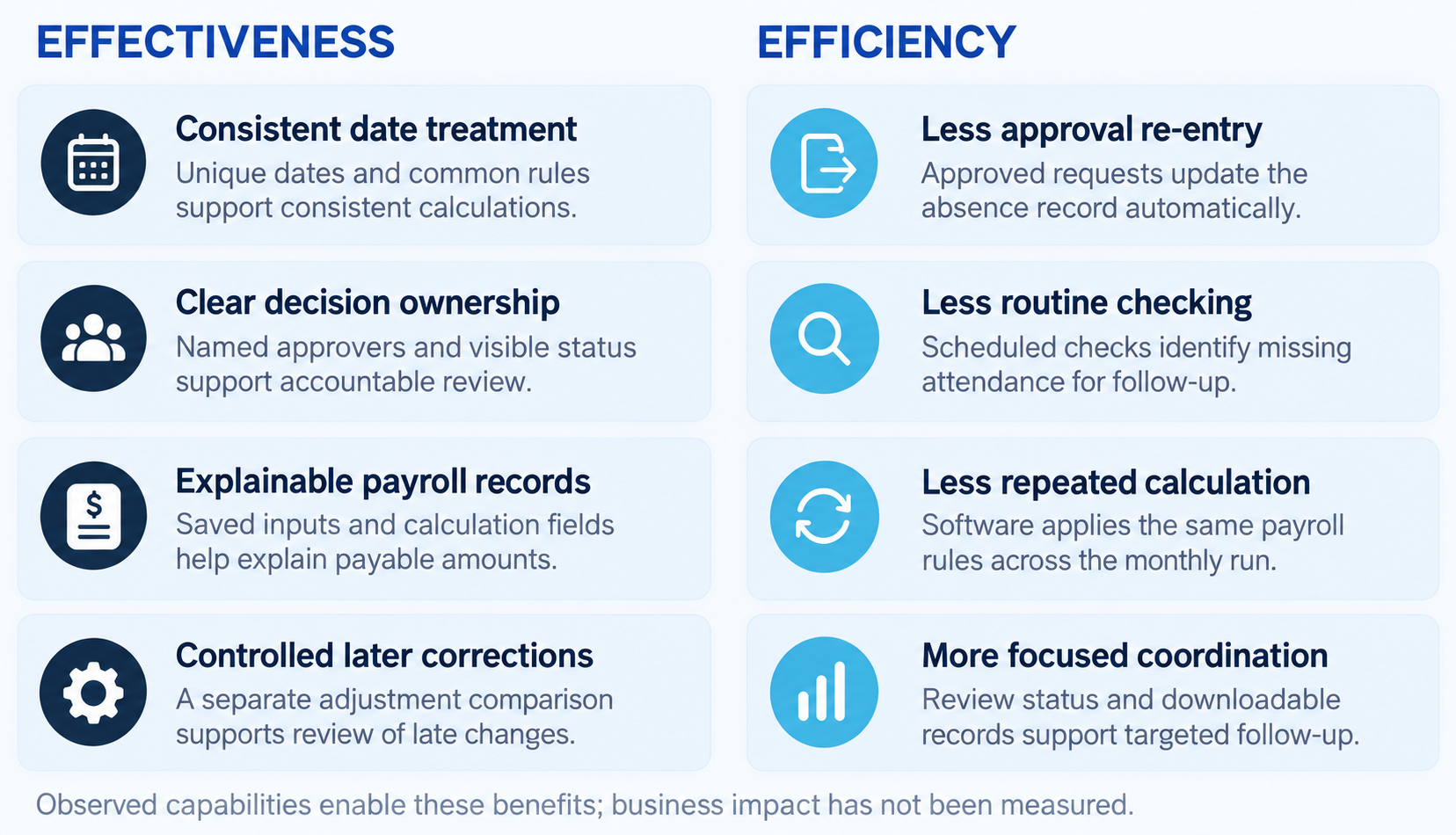
Effectiveness comes from making the payroll record more consistent and reviewable. Efficiency comes from reusing approvals, checking for missing submissions and repeating calculations through software. The map connects implemented mechanisms to the business value they enable.
Evidence behind the value
OBSERVED CAPABILITIES
The implementation creates approved-absence records, applies payroll rules, exposes review status and produces payroll and correction exports.
ENABLED BUSINESS BENEFITS
Those mechanisms can reduce administrative repetition and support more reliable review. Their actual effect on time, errors or cost has not been measured.
Measured benefits No quantified business outcomes are established. A future outcome study should compare payroll-close time, manual touches and correction rates across defined periods.
A missing attendance submission is a review signal, not automatically a final unpaid day. Approved absences and the applicable policy must be considered in the payroll calculation.
EXECUTIVE CASE STUDY / 06
A reusable operating pattern
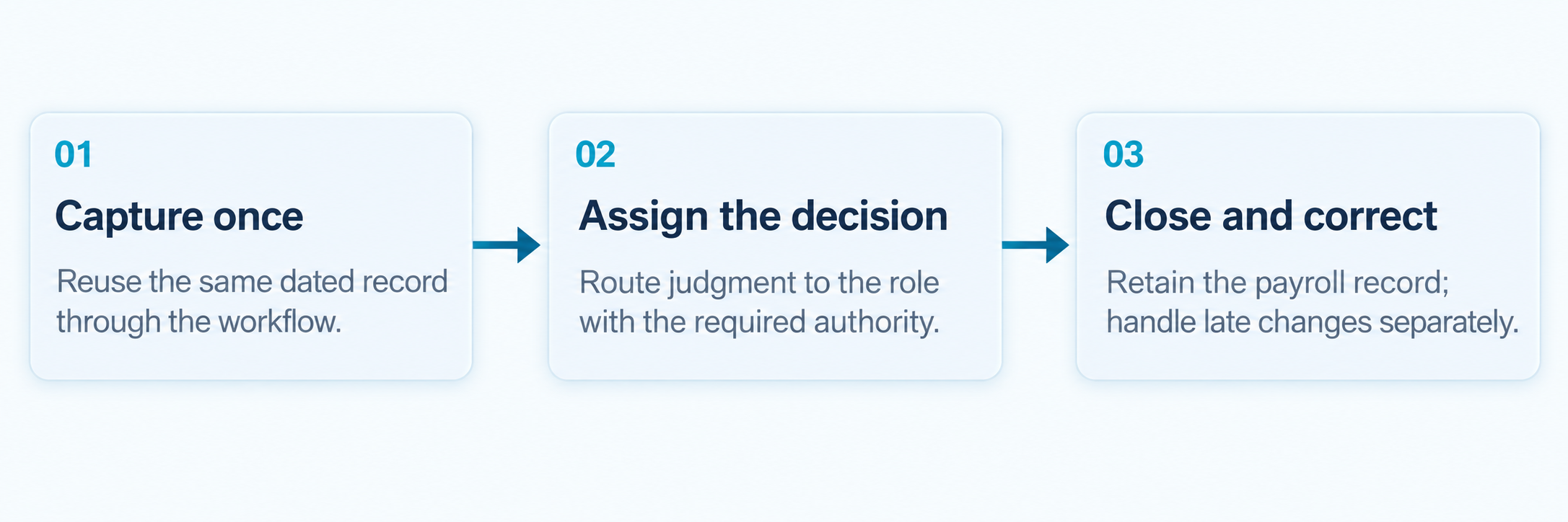
This pattern is useful wherever daily records become the basis for a periodic financial decision. Attendance and leave are the immediate use case: several roles contribute facts and approvals, while one operating team must turn them into a dependable monthly result.
APPLICABLE FUNCTIONS
HR maintains staff and policy information. Line management confirms team information. Finance prepares pay. Administrators control access and exceptional corrections.
APPLICABLE ORGANIZATIONS
Organizations coordinating payroll across multiple managers, distributed teams or a mix of employees and contingent staff, especially where approval evidence is disconnected from payroll inputs.
What can be reused and what must change
REUSABLE DESIGN
A shared dated record; role-specific review; decision-to-record updates; calendar-driven checks; monthly close controls; separate correction comparisons.
COMPANY-SPECIFIC DESIGN
Work calendars, pay and leave policies, worker categories, approval authorities, identity and email providers, payment interfaces and applicable compliance requirements.
A practical starting point Map the records and approvals required for one monthly close. Identify where information is re-entered or chased, then define the decision owners and correction path before choosing the software or any future AI role.
What this case demonstrates
The value comes from redesigning the handoff between daily work records, human approval and payroll preparation. Purpose-built software carries approved information forward, applies repeatable rules and makes unresolved work visible. This implementation demonstrates that operating pattern through ordinary software and automation, while leaving judgment and financial action with accountable people.
WORKFLOW TRANSFORMATION |