EXECUTIVE EFFECTIVENESS AND EFFICIENCY
Turning fragmented information into executive action
An anonymized workflow-transformation case study
Business challenge
An executive overseeing several business activities receives decisions, requests and updates through separate mailboxes and meeting records. A message may be current, superseded, already handled or waiting on someone else. The practical task is to identify what needs attention now and preserve the context needed to act.
Objective
Create a repeatable daily review that brings together priorities, commitments and unresolved steps while keeping the executive responsible for judgment and action.
Solution
The application combines a custom mail connector, an AI agent, available connected sources, a written attention policy, retained context and document software. It delivers a dated action brief and can create requested, unsent reply drafts for executive review.
Value created
The reviewed workflow demonstrates:
- One view of decisions, commitments and follow-ups.
- Current context carried across review cycles.
- Known deadlines, owners and sources made explicit.
- Coverage gaps disclosed before action.
Less repeated preparation and more focused review are enabled; their effect has not been measured.
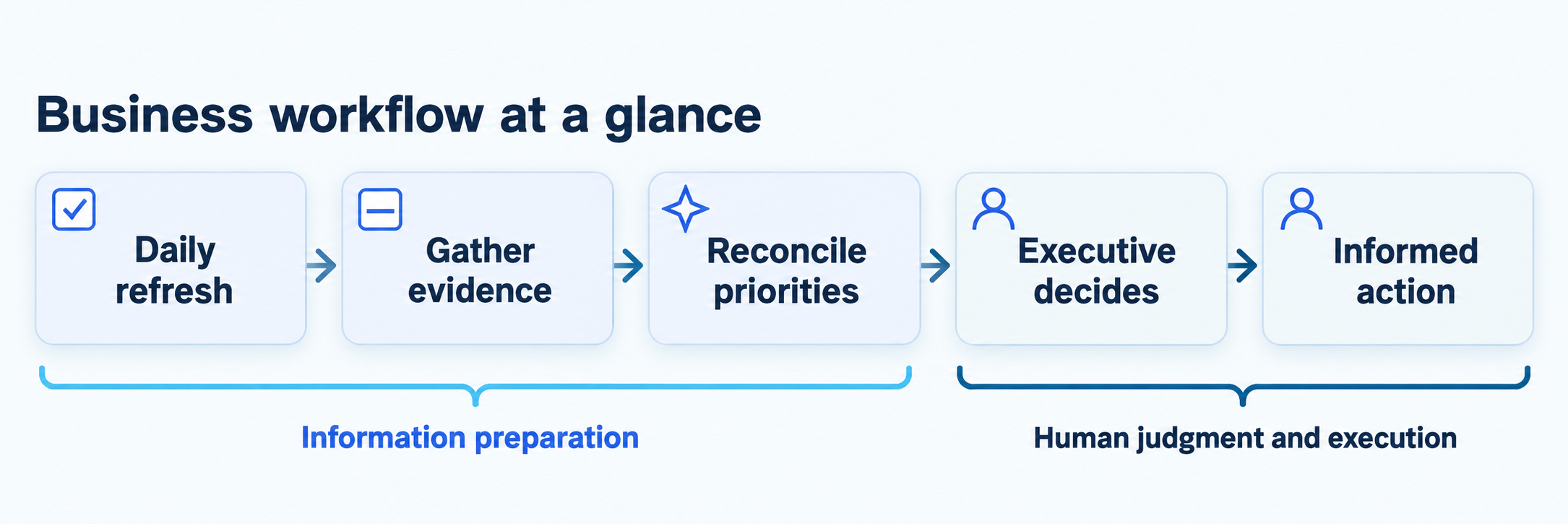
A repeatable preparation cycle brings decisions to the executive; people carry out the resulting actions.
01 THE STARTING POINT
The business workflow
The daily question is practical: what requires a decision, a reply, a review in another system, or follow-through by a functional owner? The expected result is an informed next action so that the responsible person can act with current context.
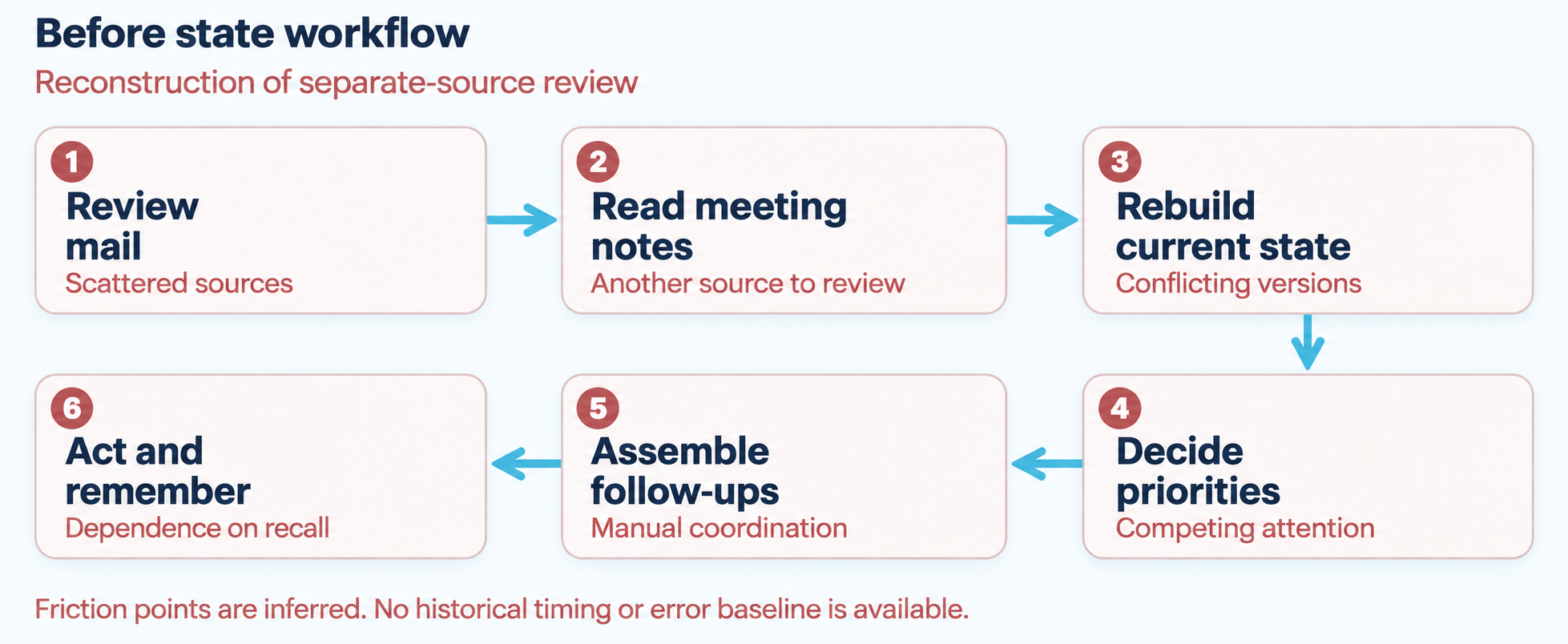
Before-state reconstruction from the information sources and workflow requirements. The exact previous routine and effort were not documented.
The problem with the traditional workflow. Each source reveals only part of the operating picture. Decisions change across conversations, while the executive must preserve ownership and determine which stage is actually complete.
Scattered evidence. A request in one mailbox may depend on a later meeting or a reply in another thread. Reviewing each source separately requires the context to be assembled again.
Uncertain current state. A reminder can outlive the work it refers to. An executive correction or an action completed outside email can change the next step without changing the earlier message.
Action hidden in notifications. A ticket or attendance request may require a decision in its original system even when no email reply is expected.
Competing attention. Routine reports, preferred reading, urgent exceptions and meeting changes arrive together. Without an explicit priority policy, the reader must repeatedly separate them.
Account access. Setup exposed a practical obstacle: both business mailboxes needed explicit access without the executive switching the active connection each time.
Dependence on recall. Commitments, owners and unfinished stages need to survive beyond a single reading session. The risk is losing the current position or asking for the same work again.
02 THE OPERATING CHANGE
The redesigned workflow
The application prepares the review across connected sources and carries forward the current position. Tailored attention rules and retained decisions address the need to know what is current across conversations. The executive receives decisions and exceptions in one place and retains responsibility for approval and execution.
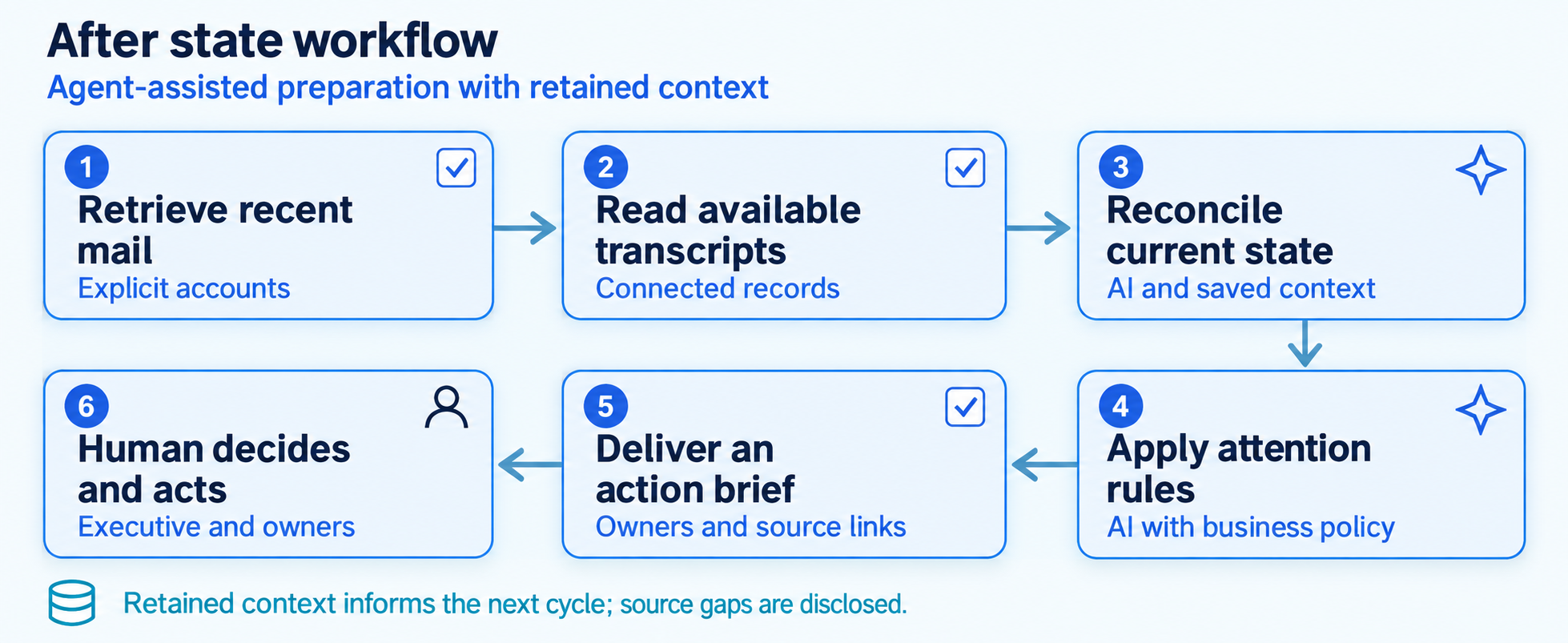
Comparable stages show agent-assisted preparation, retained context and the human decision point. Source gaps remain visible.
Gather the relevant evidence. Review recent received and sent mail through explicit account routes, available meeting transcripts and related current threads. Apply a defined review window.
Apply an attention policy. Use historical correspondence patterns and explicit priorities; tickets, requests, deadlines and exceptions take precedence. Compress routine updates and keep selected strategic reading separate from action items.
Reconcile what changed. Compare later meetings, correspondence and executive corrections with retained context. Distinguish a completed stage from the next unresolved step.
Prepare actionable follow-through. State the source, owner, known due date and recommended next action. Highlight meeting changes, duplicate notices and conflicting positions.
Preserve continuity. Update local context conservatively, keeping relevant decisions, closures and open questions available for the next review.
Deliver a checked briefing. Create and render a dated document, inspect its layout and structure, then provide a file link in the workspace. Disclose unavailable or incomplete sources.
Prepare requested replies. On explicit request, refresh the relevant thread, confirm the account and recipients, and create an unsent reply for executive review. This is separate from the daily briefing.
03 AI SOFTWARE AND HUMAN CONTROL
How the application works
A custom connector makes account selection explicit and exposes controlled mail operations. The AI workspace coordinates connected services, local context and report software. Ordinary software retrieves and stores records; AI interprets their meaning and prepares recommendations or requested replies.
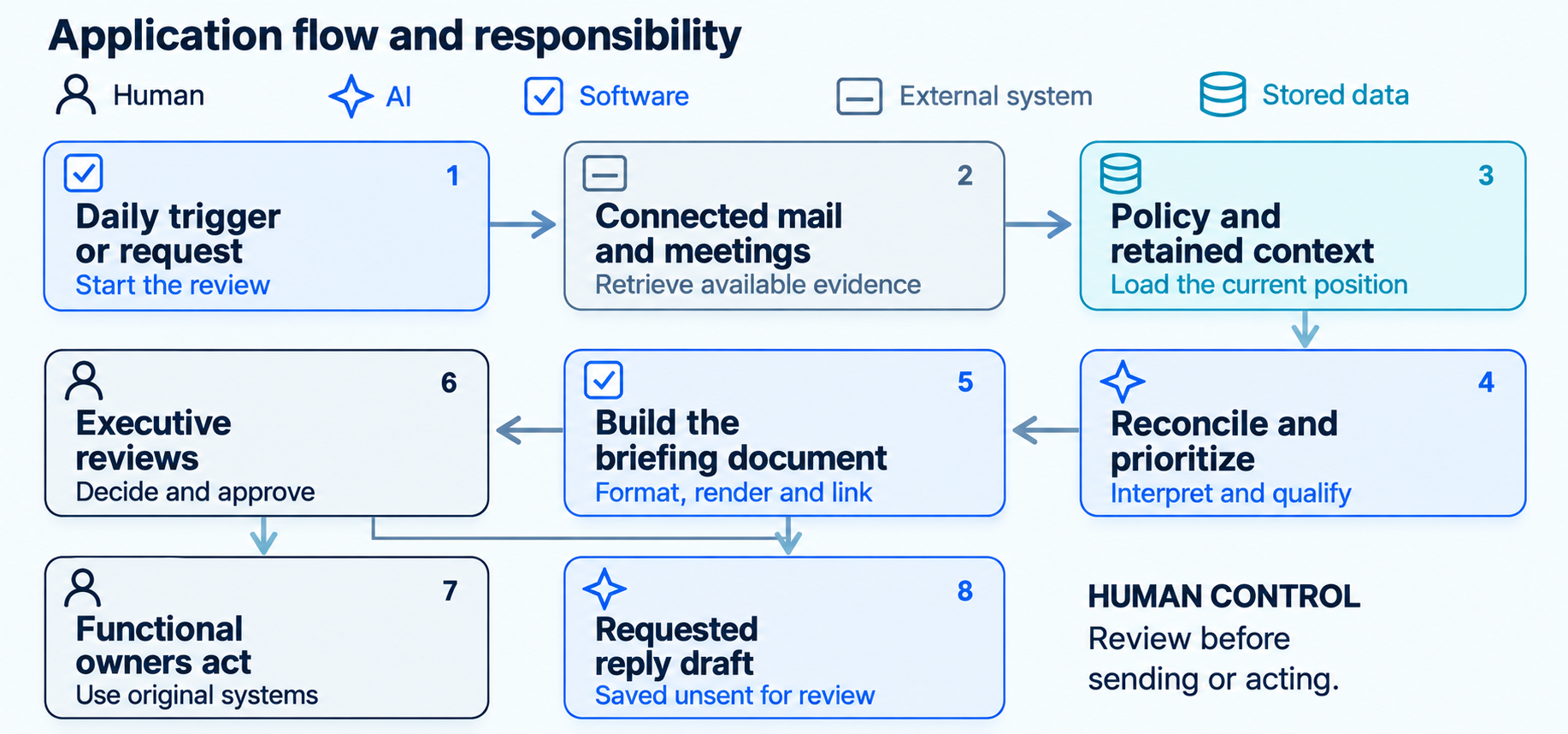
AI, software, sources, stored data and human responsibility are distinct. The optional reply path creates an unsent draft for executive review.
Inputs and processing. Connected mail and meeting services supply available records. The agent uses attention rules and retained context to interpret them, refresh related threads, compare positions and recommend priorities. A recent knowledge-page source is configured, but its discovery remained incomplete in reviewed runs.
Orchestration and outputs. A daily trigger or direct request starts the agent-led sequence. Local software produces the dated, linked briefing; the workflow also updates context records and reports what was reviewed. Connector recovery and content judgments are agent-led, not a deterministic rule engine.
Human control. Daily briefings leave external systems unchanged. Separately, an explicit request can produce an unsent reply in the chosen account and existing thread. The executive reviews and sends it. Approvals, ticket changes and operational actions remain with people.
Exceptions and visibility. Failed connections, missing transcripts, truncated notices and conflicting dates are disclosed. A verified alternative connection may be used; unresolved gaps are carried into the brief so available evidence can still be delivered. Escalation means visible human follow-up, not an automatically opened ticket.
04 EFFECTIVENESS AND EFFICIENCY
What changed
The evidence demonstrates a different way to prepare and present executive work. It does not yet quantify an improvement in executive performance. Observed means visible in the implemented workflow or reviewed outputs; enabled means a plausible benefit that has not been measured.
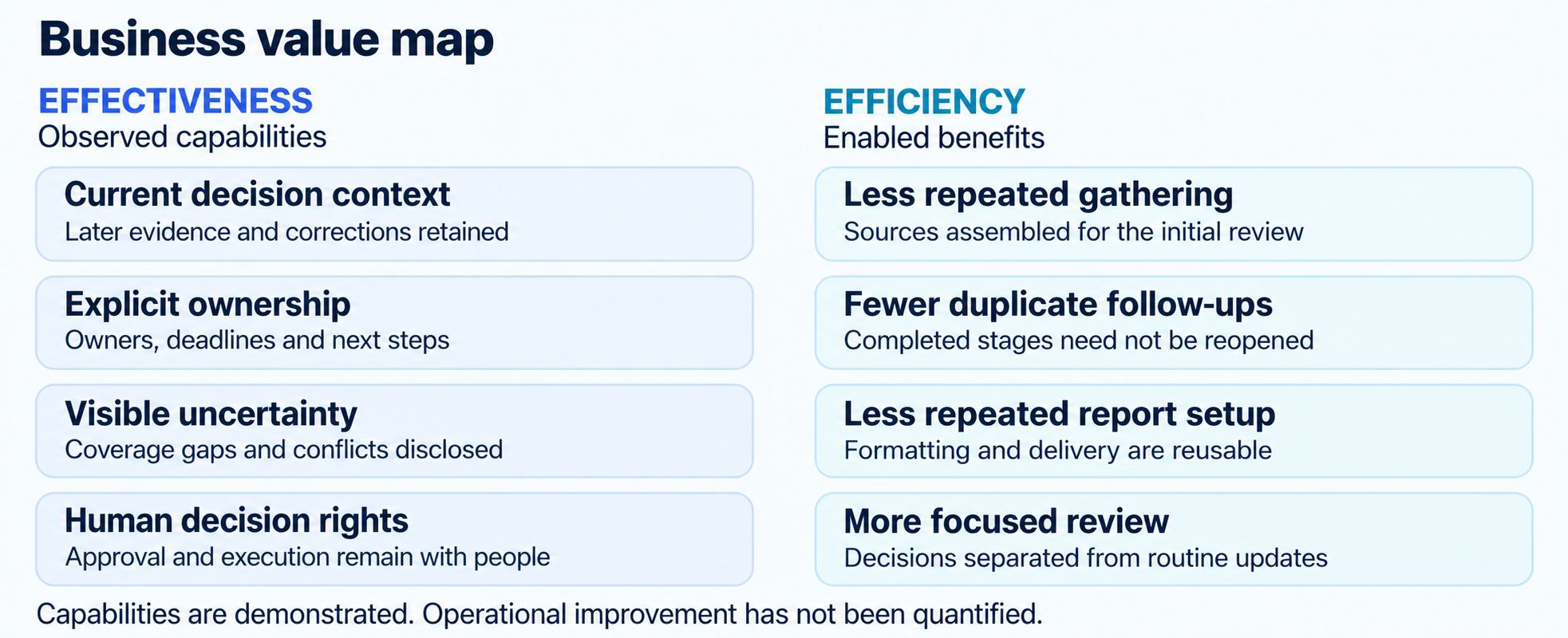
No measured savings, ROI or reduction in missed actions is claimed. Observed capabilities support the enabled benefits.
Examples visible in the briefing record. These anonymized examples show how the application changes the recommended next step. They are evidence of contextual reasoning, not an accuracy-rate claim.
Evidence received | Briefing response | Why it matters |
|---|---|---|
The executive confirms that work is underway. | Replace the earlier instruction to begin with the next follow-through step. | Preserve the current position. |
A notice reports a transfer; receipt is unconfirmed. | Close initiation follow-up and ask for confirmation of receipt. | Keep adjacent stages distinct. |
A connected knowledge source cannot be fully searched. | Deliver the available brief and explicitly disclose incomplete coverage. | Avoid presenting unknown coverage as complete. |
The executive requests a reply in an existing conversation. | Refresh the thread and create an unsent draft in the chosen account. | Prepare follow-through for review. |
05 TRANSFER TO OTHER ORGANIZATIONS
A reusable operating pattern
The recognizable pattern is an executive who must make decisions across fragmented information and changing commitments. The same design can support leadership, operations, project management, account management and professional-services teams when their work depends on that pattern.
Where the pattern fits. It is relevant to distributed or multi-function businesses where important context is spread across mail, meetings and working documents. Its value depends on source access, the quality of recorded decisions and an executive willing to review and correct the result.
What can be reused. The reusable unit is the operating cycle: bounded intake, explicit priorities, reconciliation, a clear action brief, human judgment and retained context. It does not require replacing the underlying business systems.
Reusable element | Company-specific adaptation |
|---|---|
Source intake | Authorized accounts, meeting coverage, knowledge sources and time window. |
Attention policy | Critical topics, functional roles, preferred reading and escalation thresholds. |
Decision continuity | What constitutes completion, acceptable evidence and how corrections are retained. |
Brief and reply support | Owners, approval authorities, deadline conventions, sender accounts and recipient checks. |
Controls and evaluation | Access, retention, source failures, review responsibility and success measures. |
How to establish business value. For a future evaluation, compare preparation and review effort on similar workdays, including correction effort. Track missed material actions, wrong priorities and duplicate reminders against agreed definitions. These are proposed measures, not results from this case.
What this case demonstrates. Executive effectiveness can be supported by redesigning how information becomes a current, actionable decision brief. AI performs the cross-source interpretation, software supports repeatable preparation and delivery, and people retain the decisions and actions that determine the business outcome.
APPENDIX IMPLEMENTATION AND CONTROL
Application scope and responsibilities
The following inventory makes the application boundary explicit. Observed refers to reviewed configuration, execution or outputs. A configured capability is not automatically a verified end-to-end result.
Capability | Implemented or observed scope | Boundary |
|---|---|---|
Initiation | Configured daily refresh and completed on-demand briefings. | No claim of uninterrupted scheduled execution. |
Mail connector | Custom account selection, profile checks, message/thread reads, search and draft listing. | Recent live failures required an alternate verified connection. |
Meeting context | Available transcripts compared with correspondence; dates and speaker uncertainty flagged. | Capture coverage is not a record of every meeting. |
Knowledge pages | Recent-page review and creation-time filtering are specified in the workflow. | Discovery was incomplete in reviewed runs. |
Attention and reasoning | Written priorities guide AI interpretation of tickets, requests, exceptions, routine reports and reading. | Semantic judgments remain subject to review. |
Continuity | Local policy and context files retain decisions, owners, corrections and unresolved steps. | A working record, not an immutable audit log or task database. |
Action preparation | Owners, deadlines, meeting changes and next steps appear in a structured brief. | No direct ticket write, calendar synchronization or automated task closure. |
Report and delivery | Document code formats text, tables and source links; workflow renders, checks and links the output. | Successful delivery is evidenced for reviewed runs, not an SLA. |
Requested replies | An unsent reply was created in the selected account and existing thread after refreshing context. | Requires an explicit request; executive review and sending remain separate. |
Recovery and trust | Alternate verified mail connection used after failure; missing coverage disclosed; source instructions treated as data. | Recovery is agent-led; policy is not proof of permission-level enforcement. |
Human execution | Executive and functional owners decide, approve, communicate and act in original systems. | The briefing run leaves external operational state unchanged. |
Briefing structure. Eight review sections cover immediate priorities, replies, ticket actions, meeting commitments, deadlines, changed context, information-only items and coverage.
Application boundary. The application combines custom integration code, configured AI workflows and existing services. Daily briefings are read-only; requested drafts are a separate controlled write. It does not operate the other business applications discussed in source messages.
Executive workflow transformation