EXECUTIVE WORKFLOW TRANSFORMATION CASE STUDY
From Project Baseline to
Governed Delivery
An anonymized workflow-transformation case study
A technology-enabled services organization converted a structured project baseline into a governed delivery workflow that connects execution, review, exception management, evidence, and audience-appropriate reporting.
BUSINESS CHALLENGE
A planning artifact alone could not keep day-to-day work, decisions, budgets, evidence, exceptions, and stakeholder communication connected as delivery progressed.
OBJECTIVE
Create an active system of work with clear ownership, controlled change, consistent delivery calculations, focused exception visibility, and differentiated internal and client views.
SOLUTION
A purpose-built application imports the baseline, connects operating records, enforces roles and rules, routes proposals for review, retains evidence, and generates governed reporting.
VALUE CREATED
Demonstrated governance, traceability, rule-based control, and audience boundaries. Enabled benefits include less re-keying, automatic consolidation, and more focused review; none is yet measured.
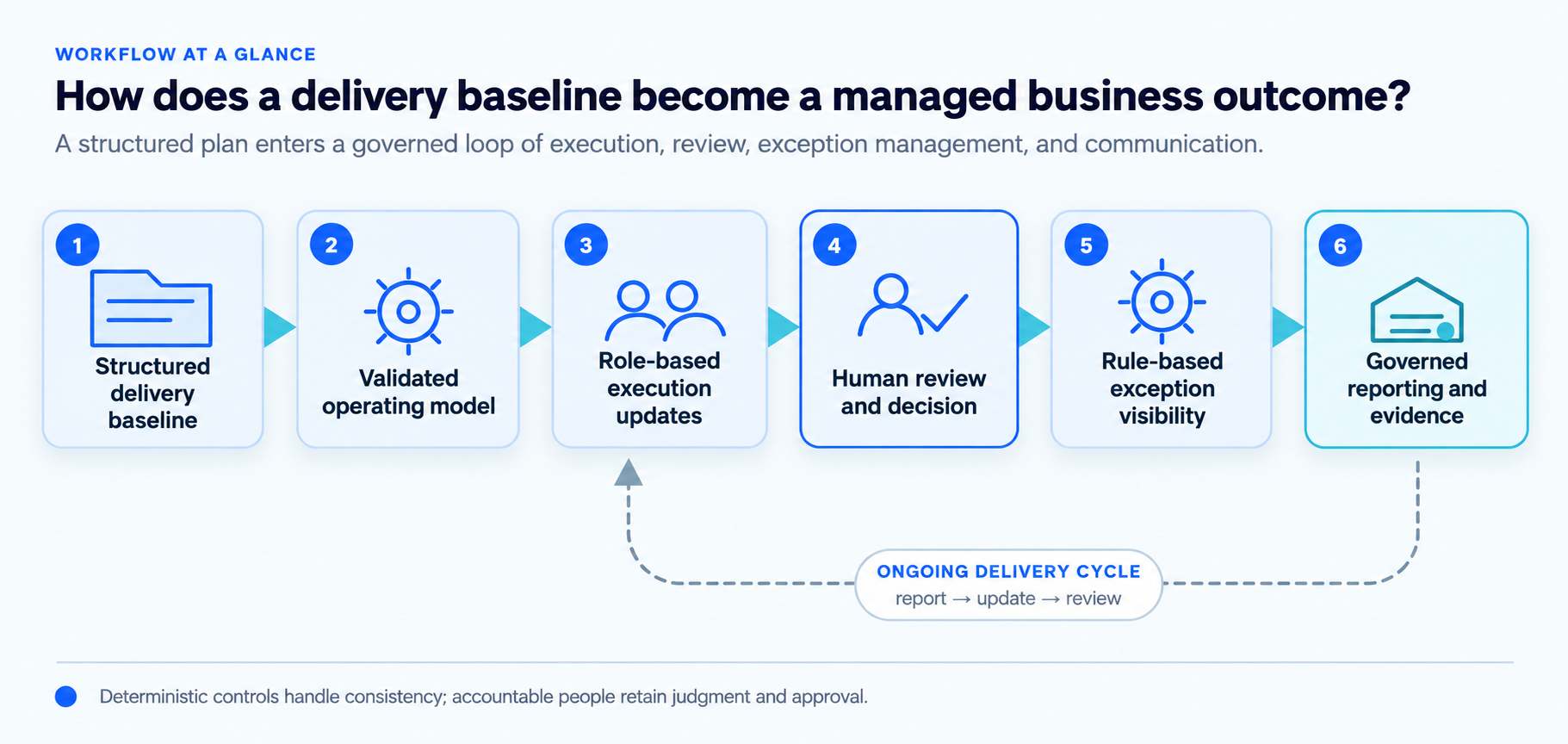
A structured plan enters a governed loop of execution, review, exception management, and communication.
BUSINESS WORKFLOW
The business workflow
The workflow begins when a new or revised structured project baseline is ready to enter active delivery. Once work is under way, each status, delivery-condition, forecast, budget, approval, or evidence update becomes a new operating event.
PARTICIPANTS
Administrators authorize access; contributors submit limited proposals; project managers update and decide; management and client viewers receive role-appropriate visibility.
INFORMATION
Hierarchy, dates, ownership, dependencies, status, forecasts, resources, budgets, registers, approvals, documents, evidence, and visibility settings move through the workflow.
DECISIONS
People judge status and forecasts, approve or reject changes, interpret exceptions, select corrective action or escalation, assess evidence, and approve external communication.
OUTCOME
Current delivery is connected to accountability, decision rights, exception visibility, evidence, and stakeholder communication—not merely to an updated plan.
The problem with the traditional workflow
The supported planning input is a structured workbook; the application adds persistent workflow, controls, and reporting around it. The before-state shown here is a design-based reconstruction, not a claim about a verified historical process.
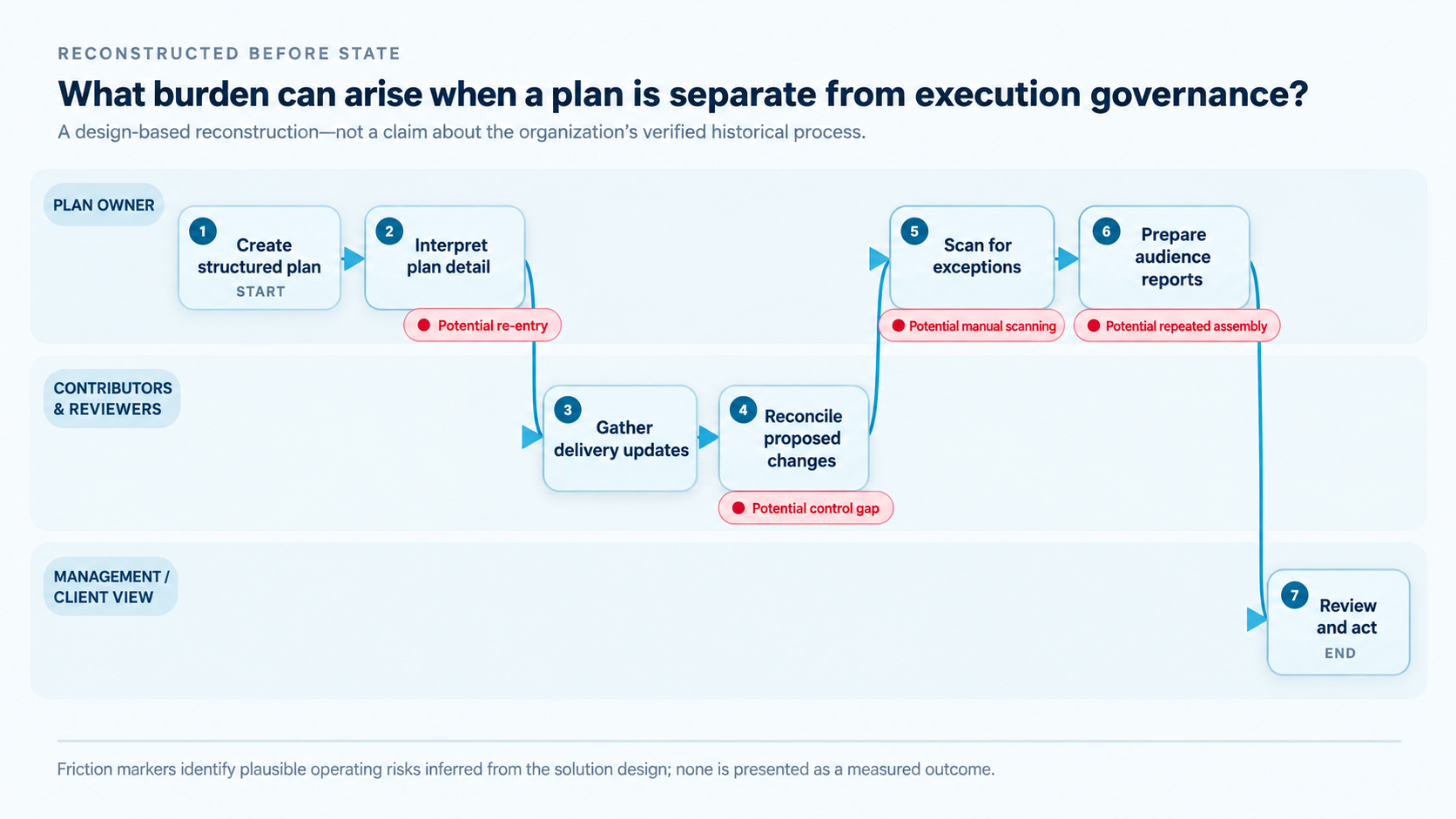
Potential frictions inferred from the solution design; none is presented as a measured outcome.
POTENTIAL COORDINATION BURDEN
Repeated interpretation or re-entry, reconciliation across status, budget, acceptance, and evidence, and a less consistent boundary around contributor changes.
POTENTIAL VISIBILITY BURDEN
Broad manual scanning for exceptions, repeated assembly of audience reports, removal of restricted information, and decision context that is harder to retain.
REDESIGNED WORKFLOW
The redesigned workflow
The redesigned workflow treats the baseline as the beginning of operations. It creates a controlled path from intake through role-based contribution, project-manager review, transparent calculations, exception response, governed reporting, and retained evidence.
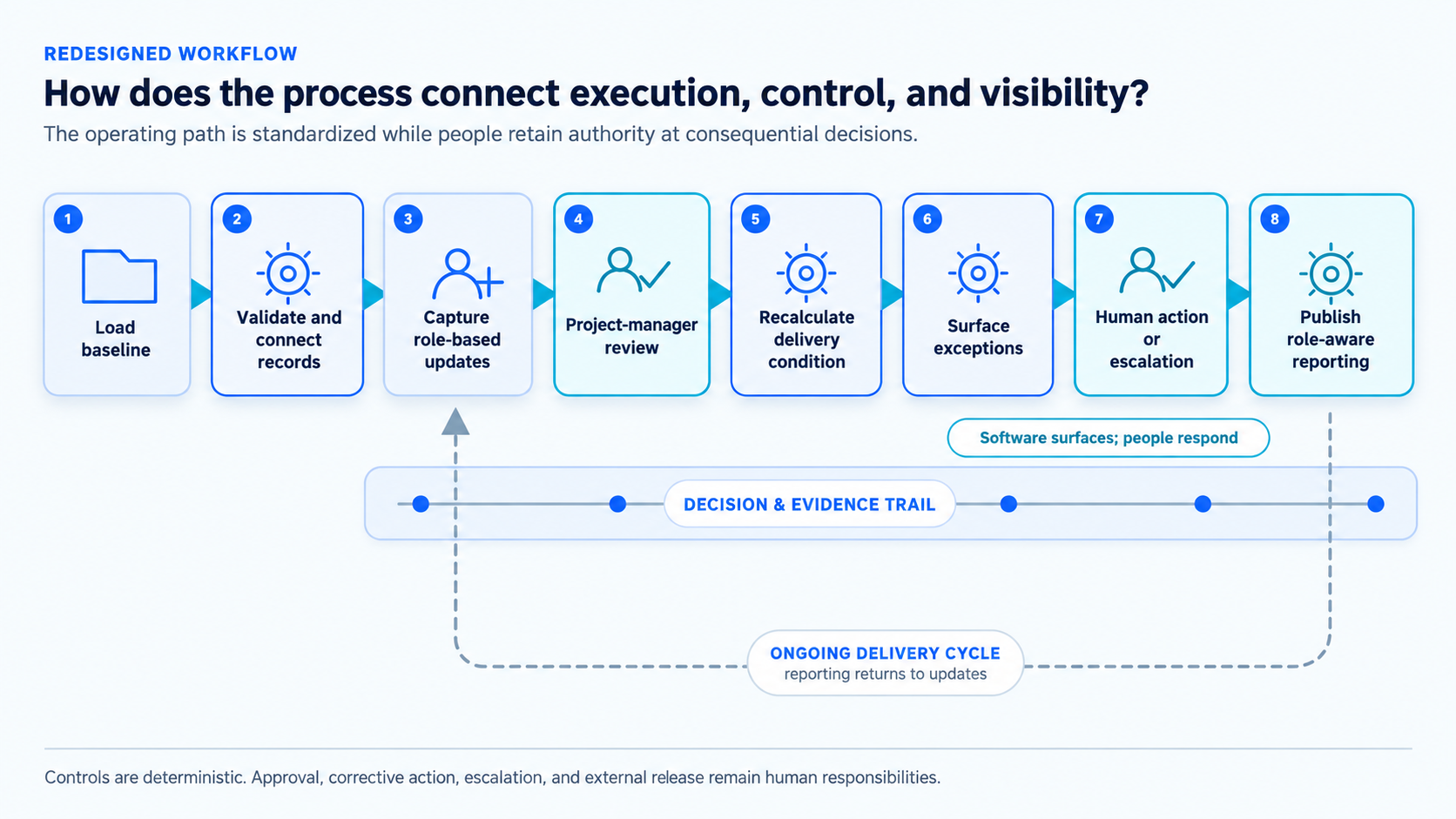
The operating path is standardized while people retain authority at consequential decisions.
What the application does
Baseline intake and control
Validates and loads structured plan data transactionally, avoiding partial replacement when validation fails.
Connected delivery structure
Relates work, dependencies, resources, budgets, registers, approvals, documents, and evidence.
Role-aligned participation
Separates administration, direct project management, contributor proposals, internal oversight, and client review.
Rules-based control
Calculates progress and budget position, enforces defined constraints, and surfaces specified exception conditions.
Decision and evidence continuity
Keeps proposals, review decisions, audit history, documents, and supporting evidence connected.
Audience-appropriate communication
Reuses governed data for dashboards and exports while applying a defined client-information boundary.
PURPOSE BUILT SOFTWARE
How the application works
The application coordinates structured inputs and controlled human updates through deterministic validation, storage, calculations, review states, and role-aware outputs. It does not substitute software logic for accountable judgment.
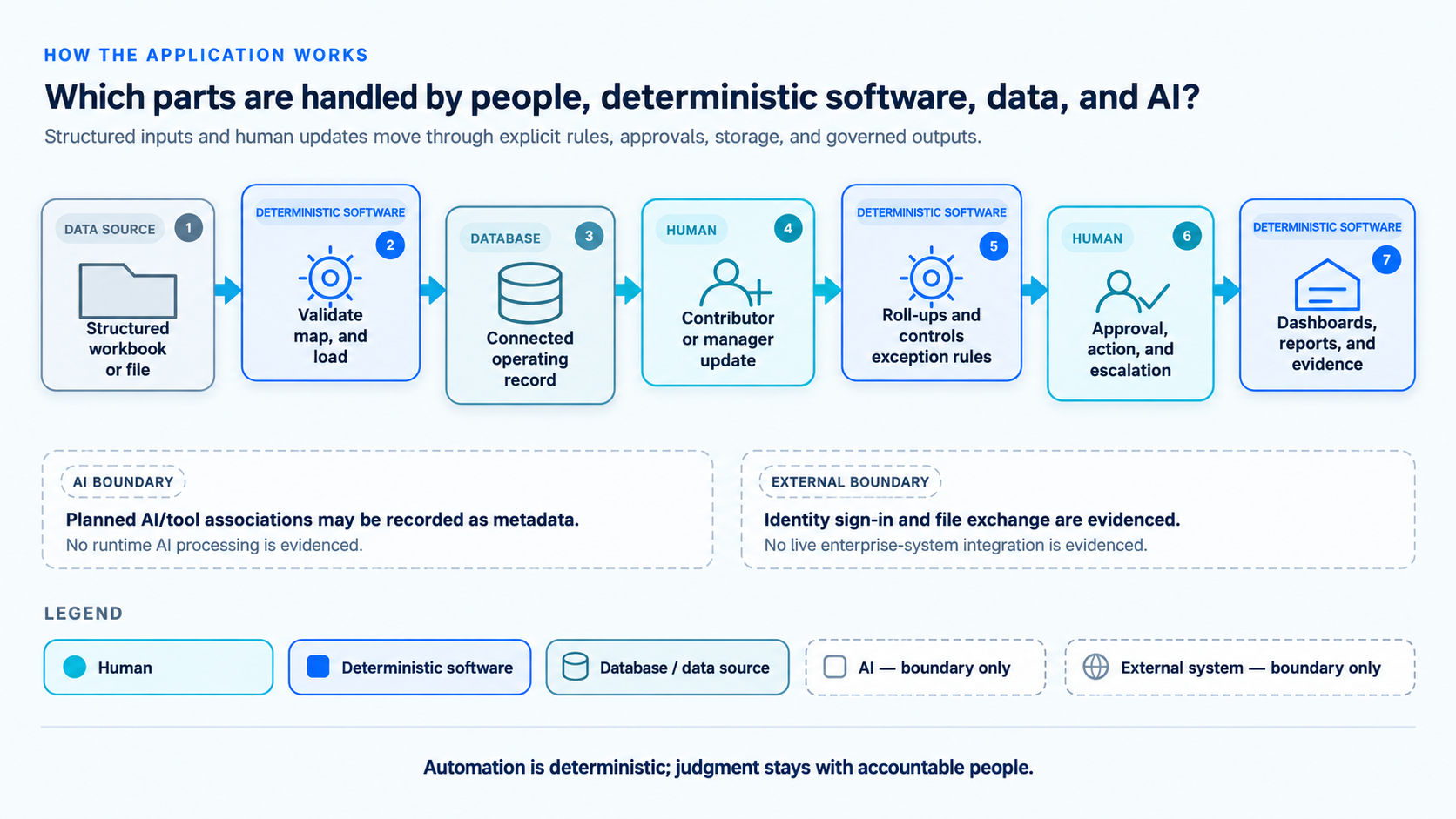
Purpose-built orchestration connects structured inputs, controlled updates, deterministic processing, and governed outputs.
Inputs
A structured workbook or combined file import, followed by human-entered delivery, financial, register, approval, document, evidence, and visibility data.
Processing
Validation, relationship mapping, operating identifiers, transactional import, roll-ups, budget arithmetic, exception rules, permissions, and audit events.
AI
No runtime AI processing is evidenced. Planned AI or tool associations may be stored as metadata, but no model predicts, prioritizes, writes, or decides.
Orchestration
Explicit roles and states move proposals to review, approved changes into current records, and governed data into calculations, views, and evidence access.
Actions
Creates and updates records, applies approved proposals, records change-request decisions, blocks invalid or over-limit actions, and generates reports.
Human control
People decide access, status, forecasts, approvals, exception response, escalation, evidence sufficiency, client visibility, and external release.
Outputs
Connected hierarchy, progress, resources, budgets, registers, approvals, alerts, evidence, audit history, archives, dashboards, reports, PDFs, workbooks, and CSVs.
Visibility
Internal roles can receive operational and financial information; client-facing views omit cost data and filter records and evidence by visibility controls.
BUSINESS VALUE
What changed
The strongest demonstrated change is structural: delivery information, control logic, review decisions, exceptions, evidence, and reporting operate as one workflow. Value should be assessed through both control effectiveness and operating efficiency.
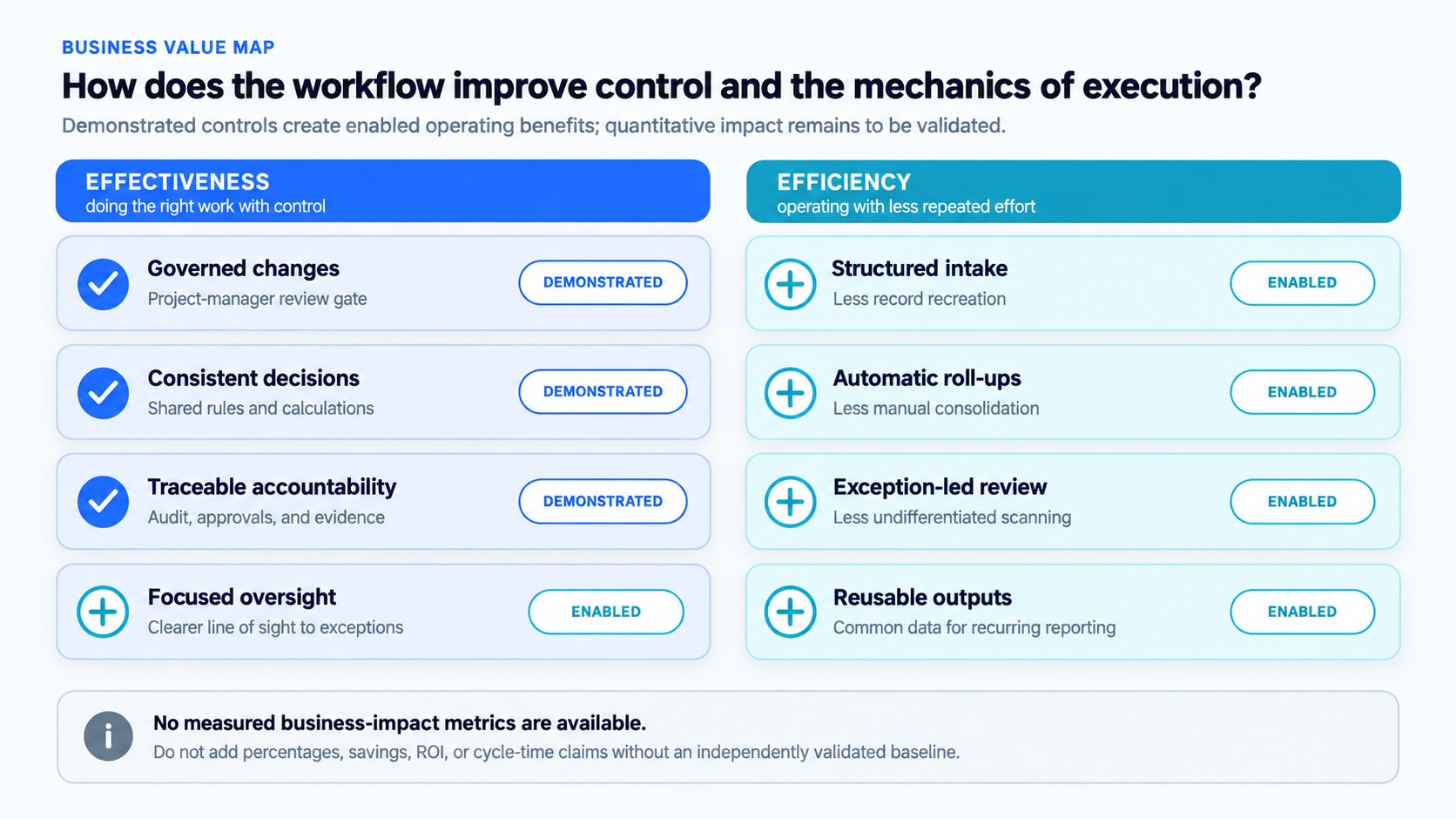
Demonstrated controls create enabled operating benefits; quantitative impact remains to be validated.
Automate the repetitive and preserve human judgment
DETERMINISTIC AUTOMATION
Validation, relationship mapping, progress arithmetic, budget checks, exception detection, role filtering, record generation, and report production are handled consistently by software.
ACCOUNTABLE JUDGMENT
People decide status and forecasts, approve changes, interpret exceptions, choose corrective action, escalate outside the application, assess evidence, grant access, and release external information.
No quantitative outcome is claimed. The workflow enables a credible foundation for greater consistency, lower coordination burden, easier scaling, and stronger review readiness, but actual effects on time, cost, throughput, quality, or staffing require a verified baseline and operating data.
TRANSFERABLE OPERATING MODEL
A reusable operating pattern
Many organizations can create plans. Fewer have a reliable mechanism for converting those plans into governed execution. This case presents a reusable pattern for shared work that needs explicit ownership, controlled decisions, explainable rules, differentiated visibility, and retained evidence.
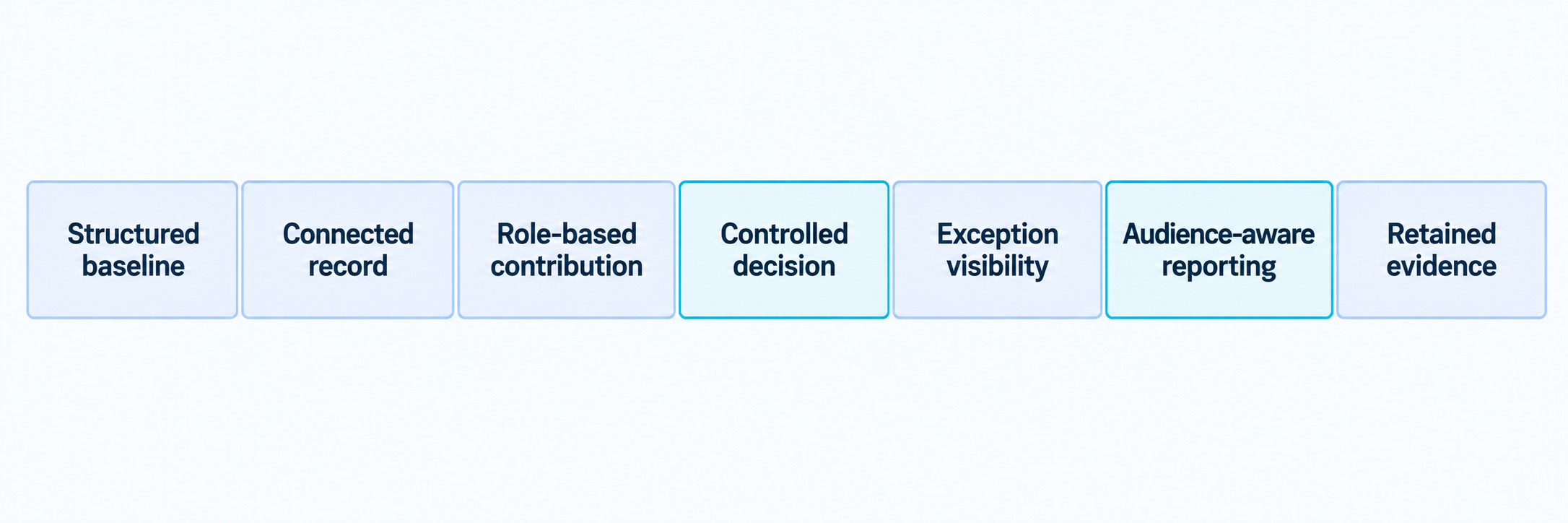
Read the diagram as text
Structured
baseline
Connected
record
Role-based
contribution
Controlled
decision
Exception
visibility
Audience-aware
reporting
Retained
evidence
A connected cycle from baseline to visible, evidence-backed delivery
WHERE THE PATTERN FITS
• Applicable functions. Project and program management, professional-services delivery, operational governance, delivery-finance oversight, quality or acceptance management, account or client communication, and executive review.
• Applicable organizations. Growing or distributed services organizations, technology-enabled operating companies, and businesses managing complex handoffs across internal teams and external stakeholders.
• Common conditions. Several people update shared work, managers must retain explicit decision rights, operating rules can be standardized, and stakeholders need different views of the same underlying record.
WHAT CAN BE REUSED
• Workflow and control. Structured intake, connected records, role-based contribution, proposal-and-approval paths, deterministic rules, and an evidence trail.
• Visibility and reporting. A common reporting layer can present governed information differently to internal and external audiences.
• Customization required. Terminology, hierarchy, roles, approval authorities, thresholds, financial controls, evidence standards, metrics, integrations, interface, compliance, and escalation procedures must reflect each organization.
• AI by design, not assumption. Introduce AI only for a defined decision-support or content-processing need, with human review and failure handling explicitly designed.
What still requires validation
Before presenting this as a realized performance transformation, confirm the former workflow, deployment and adoption status, participating functions, authoritative data source, operating cadence, exception-escalation path, and external-release governance. Claims about faster approvals, shorter reporting cycles, reduced rework, lower cost, throughput, milestone performance, or return on investment require baseline and post-change data.
What this case demonstrates
The value did not come from adding AI to an unchanged process. It came from redesigning the path from plan to execution: connecting the baseline to roles and decision rights, automating repetitive controls, directing attention to exceptions, retaining evidence, and making governed information visible to different audiences. The result is a practical blueprint for a controlled delivery operating system that automates consistency while keeping people accountable for judgment, action, escalation, and trust.