EXECUTIVE CASE STUDY
Connecting Campaign Support to Resolution and Performance Oversight
An anonymized workflow transformation case study
ORGANIZATION PROFILE
A specialist healthcare campaign services organization
WORKFLOW TRANSFORMED
Multi-system campaign support and performance orchestration
Executive summary
BUSINESS CHALLENGE
Questions and operational exceptions crossed campaign journeys, roles and data sources. Project managers had to gather context, find the right owner, follow successive handoffs and reconcile the operating picture.
OBJECTIVE
Create one operating path that resolves routine questions at source, converts unresolved issues into accountable work, preserves context and governs sensitive decisions.
SOLUTION
A purpose-built application connects contextual self-service, project manager triage, rules-based routing, owned execution, controlled escalation, integrations and management views.
VALUE CREATED
A standardized route to resolution, visible ownership and handoffs, human approval at sensitive points, and consolidated support and performance oversight.
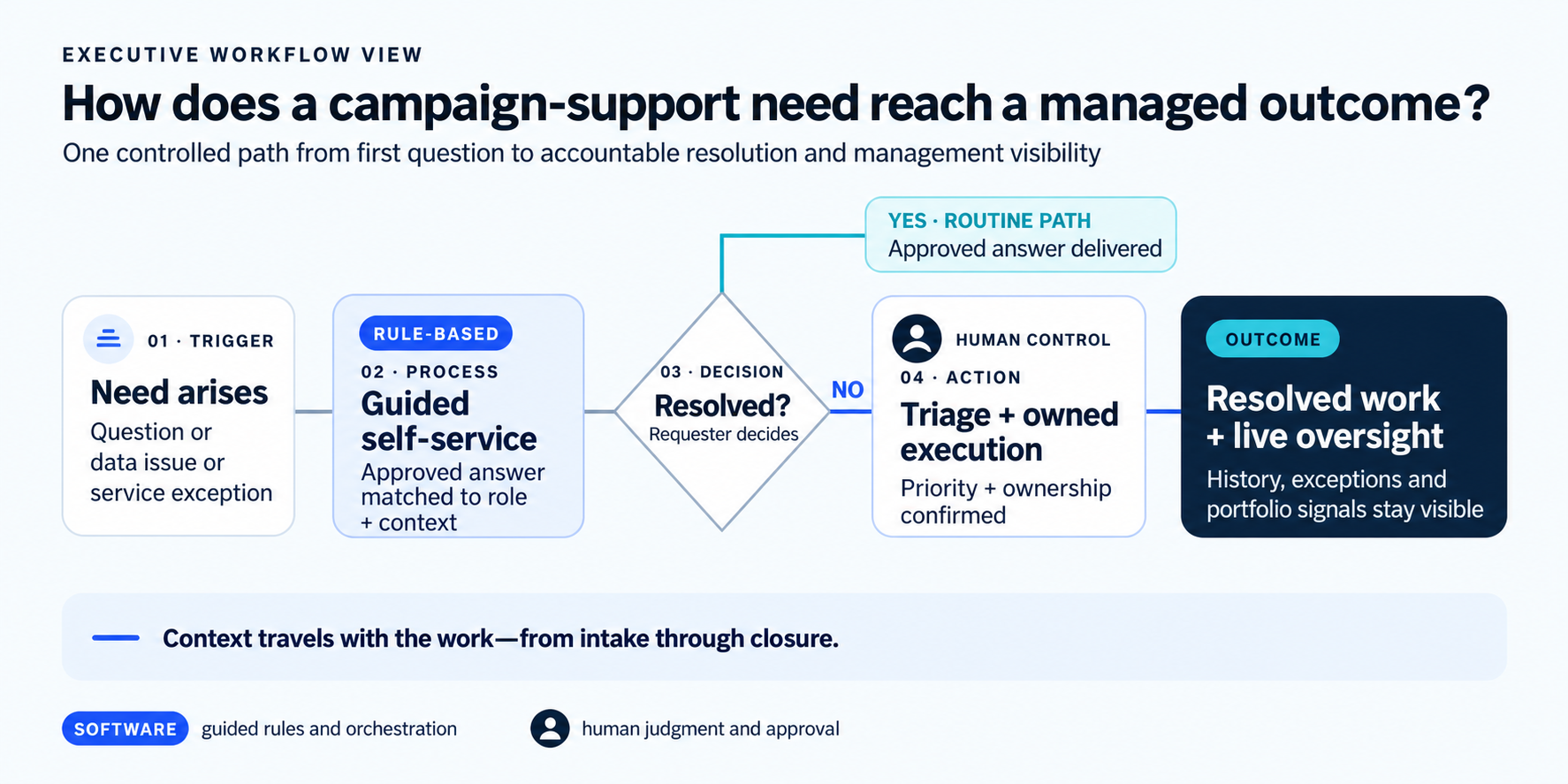
One control loop connects the moment support is needed with accountable resolution and portfolio oversight.
BUSINESS WORKFLOW
The business workflow before the application
A question, content need, data issue, service failure or special request could arise anywhere in a campaign journey. The operating goal was to provide an approved answer where possible and otherwise route a well understood issue to an accountable owner, preserve the decision trail and make the result visible.
TRIGGER
A support question, exception or instruction in a live campaign journey
PARTICIPANTS
Campaign participants, project managers, delivery owners, specialist reviewers and management
DESIRED RESULT
An approved answer or traceable resolution with ownership and oversight
Inferred before state The available project evidence supports the operating pattern below, but it does not document the exact legacy tools, volumes, timings, service levels or staffing model.
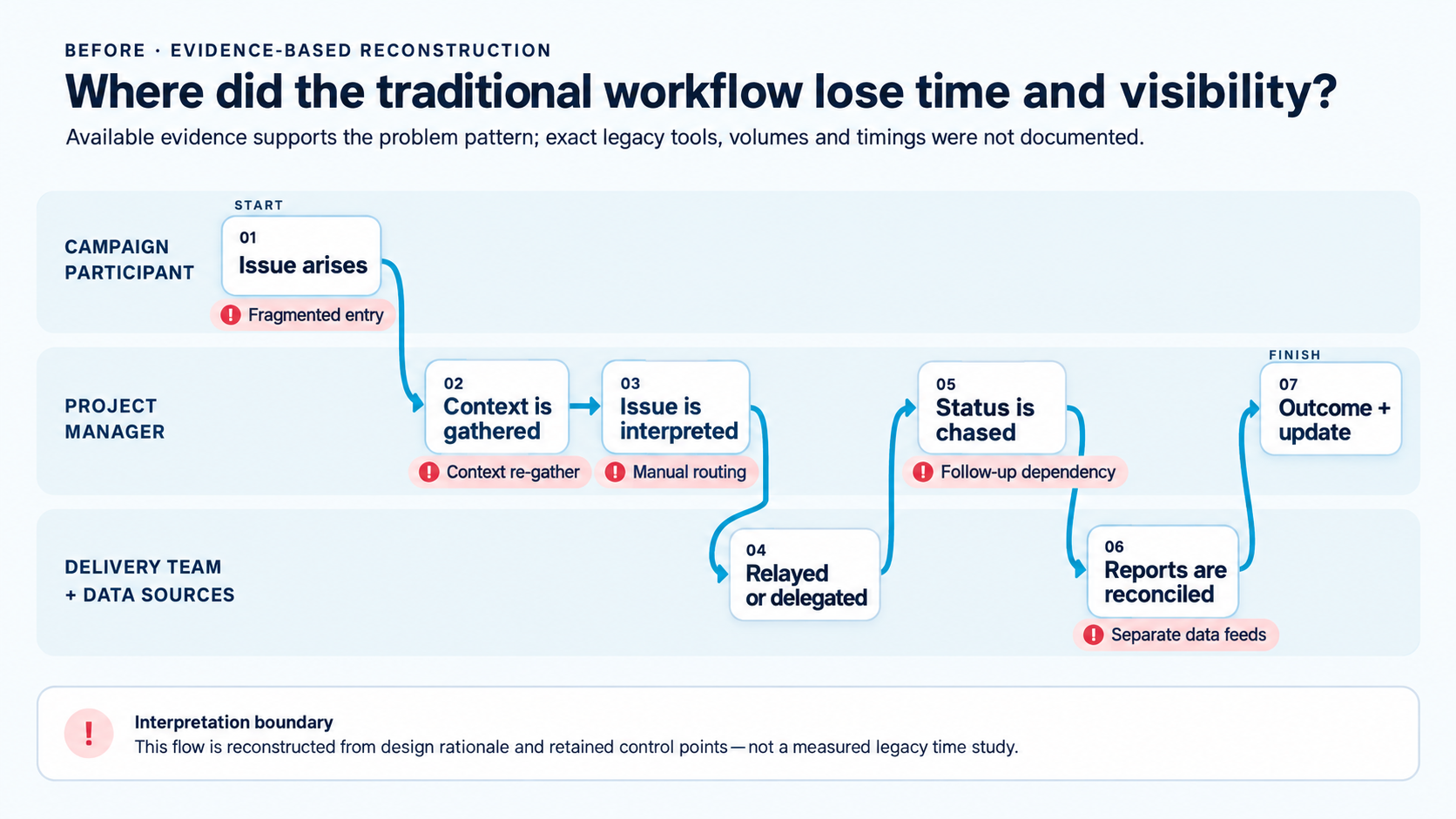
In this evidence based reconstruction, the project manager connected participants, delivery teams and management reporting.
Fragmented context Role, campaign, page and device details did not necessarily travel as one durable record.
Coordination concentrated in one role Project managers carried interpretation, routing, follow up and reporting work.
Repeated handoffs Clarification, delegation and return created additional coordination points.
Unclear operating state Ownership, priority, age and completion were harder to assess consistently.
Governed escalation was needed Critical work required a controlled route to responsible stakeholders.
Separate views Support issues and campaign performance could be reviewed in different places.
DECISIONS AND HANDOFFS
The project manager interpreted the issue, identified the owner and followed clarification, delegation, return and escalation.
MANAGEMENT VISIBILITY
Support status and campaign delivery signals could require reconciliation across separate sources before leaders saw the full operating picture.
REDESIGNED CONTROL LOOP
The redesigned workflow
The redesign connects routine knowledge, unresolved intake, formal execution, escalation and management visibility. Context and control follow the issue from the point of need rather than being reconstructed at each handoff.
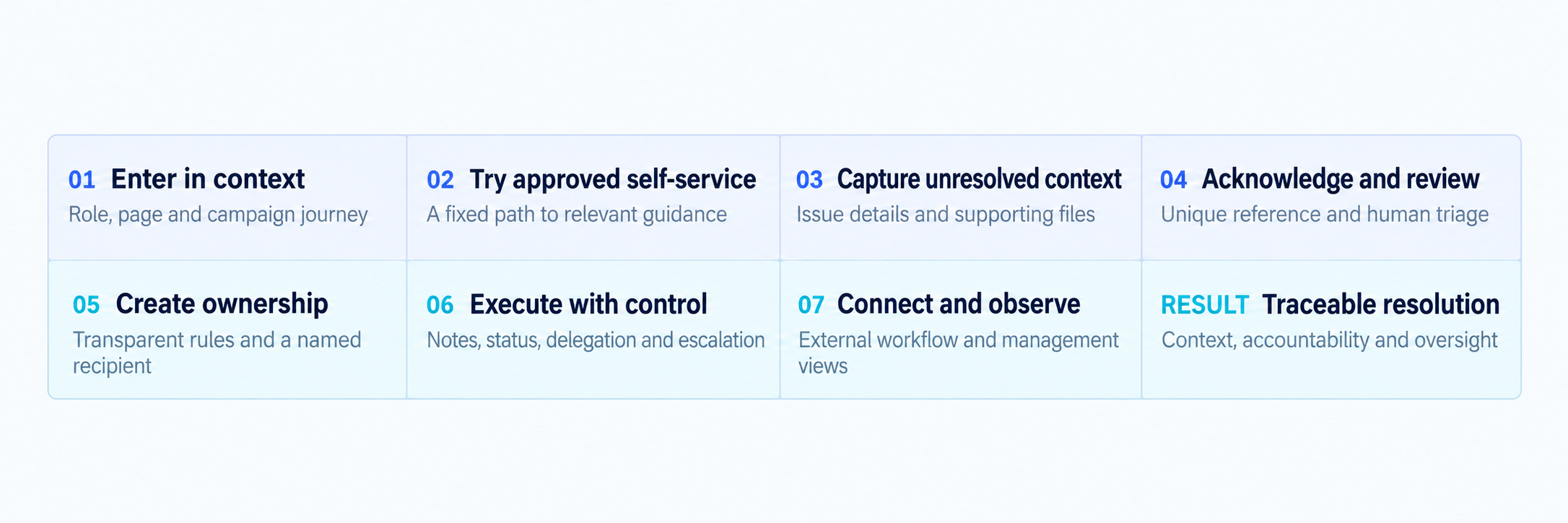
Read the diagram as text
01 Enter in context
Role, page and campaign journey
02 Try approved self-service
A fixed path to relevant guidance
03 Capture unresolved context
Issue details and supporting files
04 Acknowledge and review
Unique reference and human triage
05 Create ownership
Transparent rules and a named recipient
06 Execute with control
Notes, status, delegation and escalation
07 Connect and observe
External workflow and management views
RESULT Traceable resolution
Context, accountability and oversight
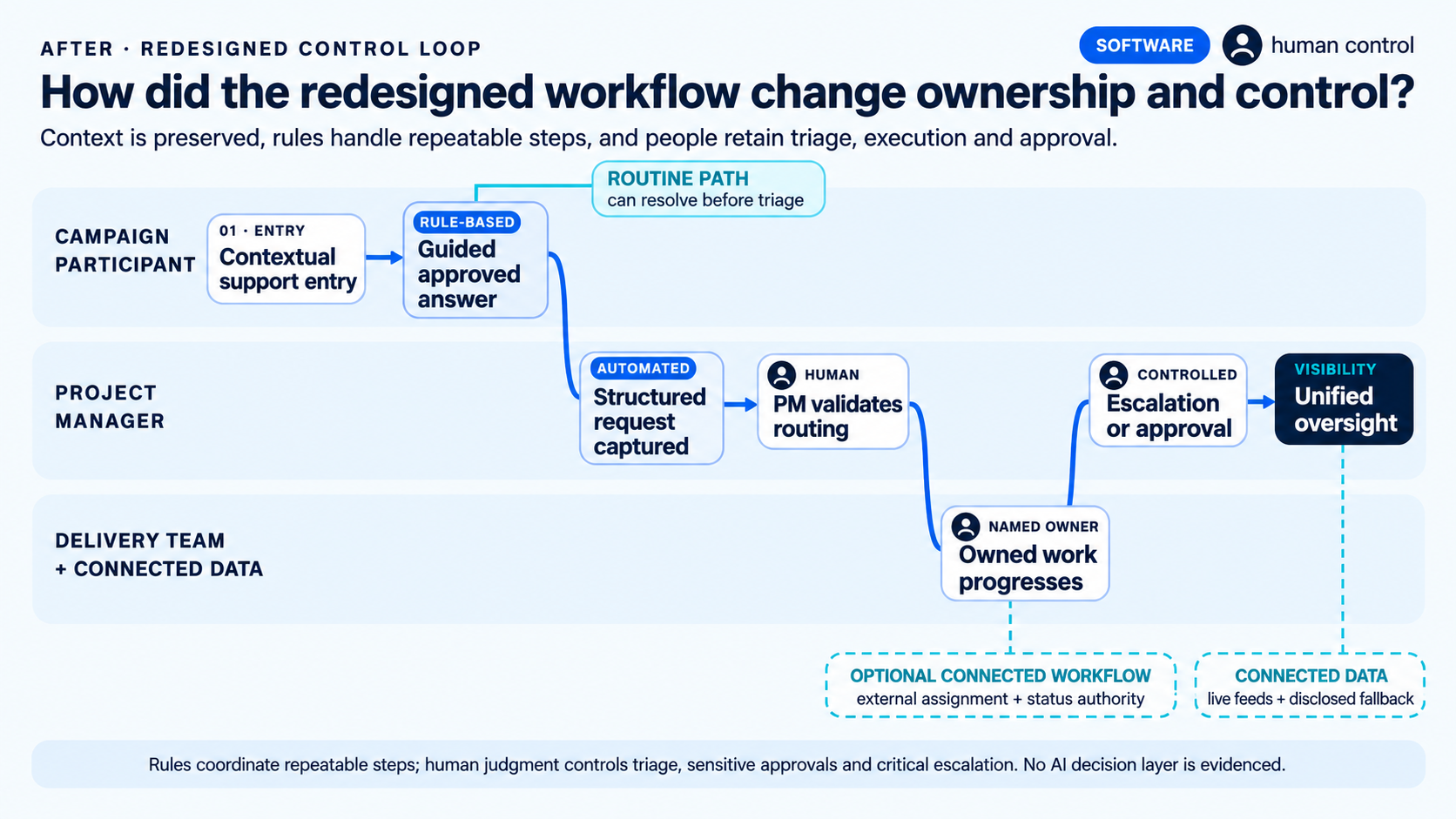
The redesigned workflow carries context, ownership and control from the point of need through resolution.
Support in business context Approved knowledge is filtered by participant and campaign journey.
Structured exception intake Unresolved requests keep their original context and supporting material.
Accountable ownership Department mappings and permissions define who can act.
Governed priority Critical escalation and sensitive outbound actions retain human control.
Connected operations Eligible work can be mirrored without hiding synchronization failure.
Management visibility Queue, activity, performance and source health appear in operating views.
CONTEXT
Before Reconstructed at handoffs
After Preserved from entry
ROUTING
Before Interpreted manually
After Rules proposed and a manager validates
OVERSIGHT
Before Status chased and reports reconciled
After Owned lifecycle and unified operating view
PURPOSE BUILT APPLICATION
How the application works
The application is an orchestration layer around participant support, internal execution and management visibility. It connects existing sources where useful while preserving a recoverable local workflow record.
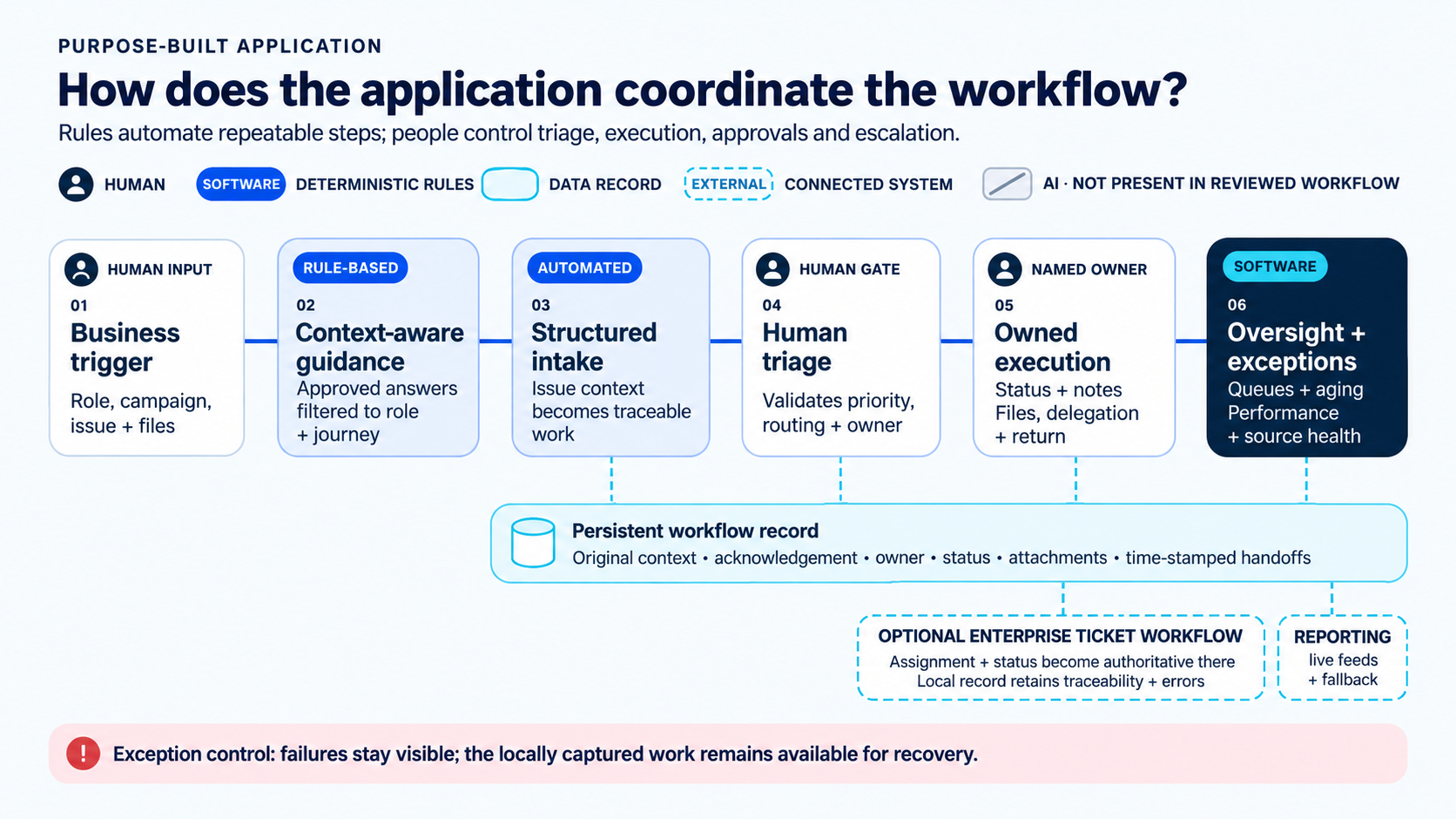
Transparent rules automate repeatable coordination while people retain the decisions that control ownership and risk.
SOFTWARE AND AUTOMATION
Inputs Participant, campaign, page, issue, device, file, routing and performance context.
Processing Fixed guidance paths, validation, taxonomy, keyword rules, permissions and owner assignment.
Actions Acknowledgements, notifications, routing history, connected ticket updates and visible fallback reporting.
Outputs Approved answers, traceable work items, documented decisions and operating views.
HUMAN CONTROL
Participant Confirms whether an approved answer resolves the issue.
Project manager Validates intake, adjusts routing and authorizes critical escalation.
Delivery owner Performs the work, documents progress, delegates or returns it.
Designated reviewers Approve sensitive responses and externally initiated instructions.
AI boundary No generative, predictive or autonomous AI is evidenced in the implemented decision path. The guided assistant and classification logic are deterministic and rules-based.
Exception resilience
Ownership missing Unsafe routing is blocked or safely downgraded.
Ticket sync fails The local work item remains available for recovery.
Live source unavailable A local snapshot is shown and labeled as fallback.
Identifiers do not align Available data remains visible with a mapping notice.
Source detail is limited The proxy measure and its limitation are labeled.
Approval update fails The failure state is stored for follow up.
BUSINESS VALUE
What changed
The implementation establishes a different operating capability. The evidence supports observed features and enabled benefits, but it does not establish a percentage improvement, financial return or production adoption level.
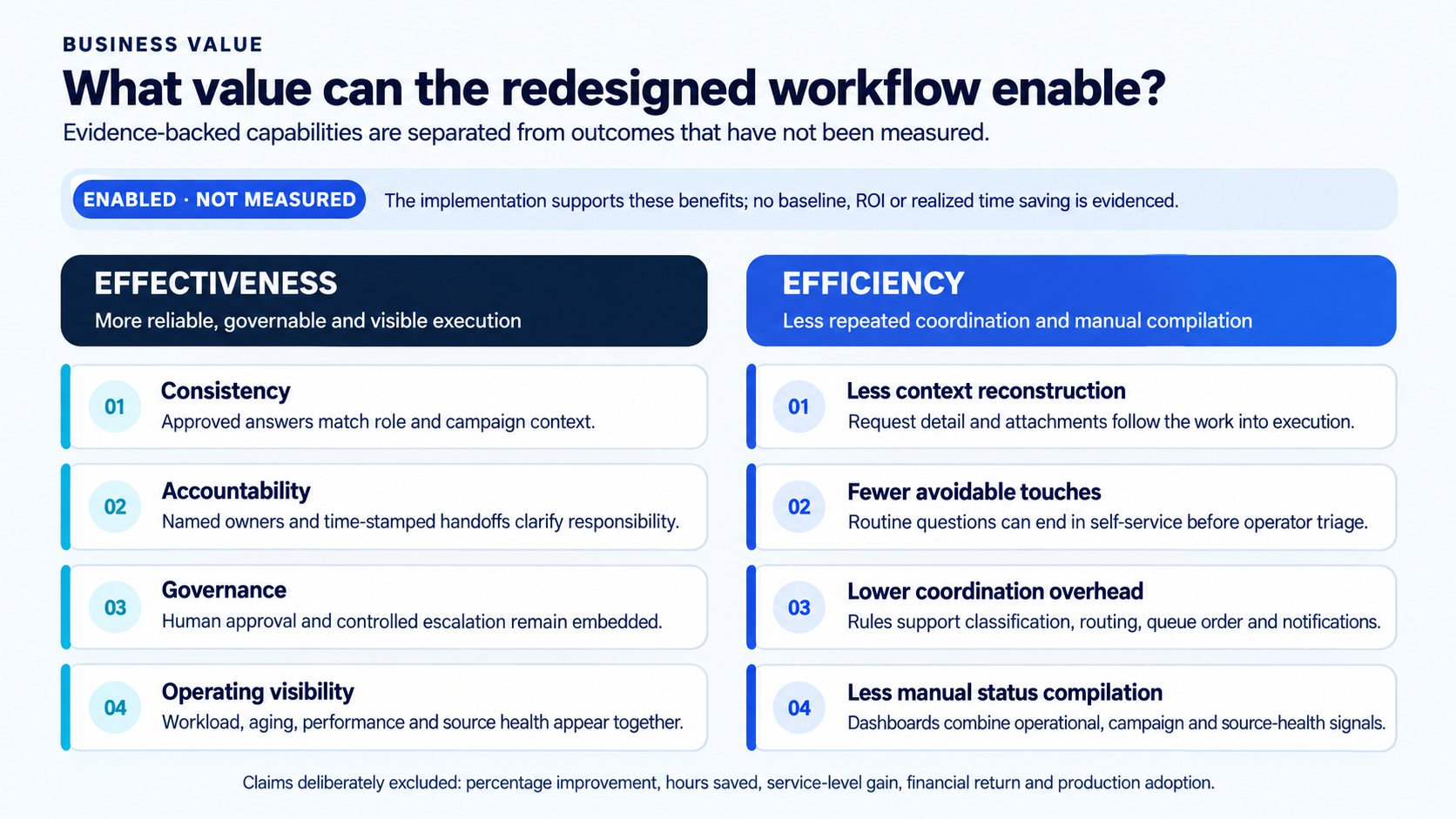
The workflow strengthens control and visibility while enabling less manual coordination around the work.
OBSERVED CAPABILITIES
Consistent support Relevant approved guidance appears before escalation.
Accountability Named ownership, permissions and handoff history are built in.
Governance Human triage, escalation and approvals remain explicit.
Visibility Queue, activity, performance and source health are consolidated.
ENABLED BENEFITS
Fewer avoidable touches Routine questions can resolve before operator work.
Less context reconstruction Original issue details can travel into execution.
Lower coordination burden Rules, notifications and mirroring can replace manual relaying.
Less status compilation Managers can review connected operating signals in one view.
OBSERVED
Implemented capabilities visible in the reviewed application
ENABLED
Credible structural benefits that have not been measured
MEASURED
No validated quantitative business outcome was available
What is deliberately not claimed No validated before-and-after dataset was available for handling time, resolution time, ticket reduction, cost savings, user satisfaction, campaign performance, adoption, compliance outcomes or return on investment.
TRANSFERABLE OPERATING PATTERN
A reusable operating pattern
Many organizations run customer or operational journeys across several systems while relying on a coordinator to interpret exceptions, collect missing information, route work, chase updates and assemble management reporting. The workflow pattern in this case is transferable even though each organization needs its own operating rules.
The common pattern Guide routine demand • capture unresolved context • apply transparent rules • insert human judgment • assign accountable ownership • govern exceptions • make operating performance visible
REUSABLE DESIGN PATTERNS
Contextual self-service Resolve routine demand without removing the route to human help.
Two-stage intake Separate acknowledgement from formal commitment and retain a triage gate.
Transparent routing Make classification and ownership repeatable, inspectable and overridable.
Permissioned execution Clarify who may act and preserve how responsibility moved.
Governed exceptions Prevent sensitive actions from bypassing defined authority.
Resilient integration Connect established tools while retaining visible, recoverable local state.
Control views Give managers one picture of work, exceptions and source health.
CUSTOMIZATION REQUIRED
Participants and journeys Roles, entry points and approved knowledge.
Business rules Categories, priorities, routing, escalation criteria and service expectations.
Decision rights Owners, delegates, approval authorities and human override.
Connected systems Ticket platforms, notification channels, upstream services and data sources.
Management measures Definitions, source quality, proxies and reporting limitations.
Compliance controls Access, evidence retention and requirements for sensitive decisions.
Future AI role Purpose, validation and human control if a model is later introduced.
APPLICABLE FUNCTIONS
Customer support, operations, project delivery, account management, professional services, internal service desks and compliance
APPLICABLE ORGANIZATIONS
Growing SMEs, distributed service organizations, multi-function businesses and companies using disconnected operating systems
What this case demonstrates
The value came from redesigning the end-to-end control loop, building software around the improved workflow, automating repeatable coordination, preserving human judgment where ownership or risk is determined and making the operating state visible. Purpose-built software creates leverage when it carries context, responsibility and governance across the workflow.
Evidence note The prior state is a reasonable reconstruction from project materials rather than a contemporaneous process study. Production deployment, active integrations and scheduled automations, adoption and realized outcomes require client confirmation. Some reporting measures use disclosed proxies, and detailed activity history begins only when enhanced tracking was introduced.
ANONYMIZED WORKFLOW TRANSFORMATION CASE STUDY