EXECUTIVE WORKFLOW TRANSFORMATION CASE STUDY
From Disconnected Clinic Outreach to Coordinated Pediatric Screening and Follow Up
An anonymized workflow transformation case study
BUSINESS CHALLENGE
A multi-role health program needed to connect program setup, clinic activation, patient screening, follow-up and oversight without losing context at each handoff.
OBJECTIVE
Create one controlled workflow for verified multilingual intake, consistent risk routing, clinic action and current operating visibility.
SOLUTION
A purpose-built web application now links role-based activation, deterministic alert rules, immediate guidance, reports, reminders and management views.
VALUE CREATED
Shared context, standardized execution, direct routing to a next action, visible exceptions and human control at clinical decisions.
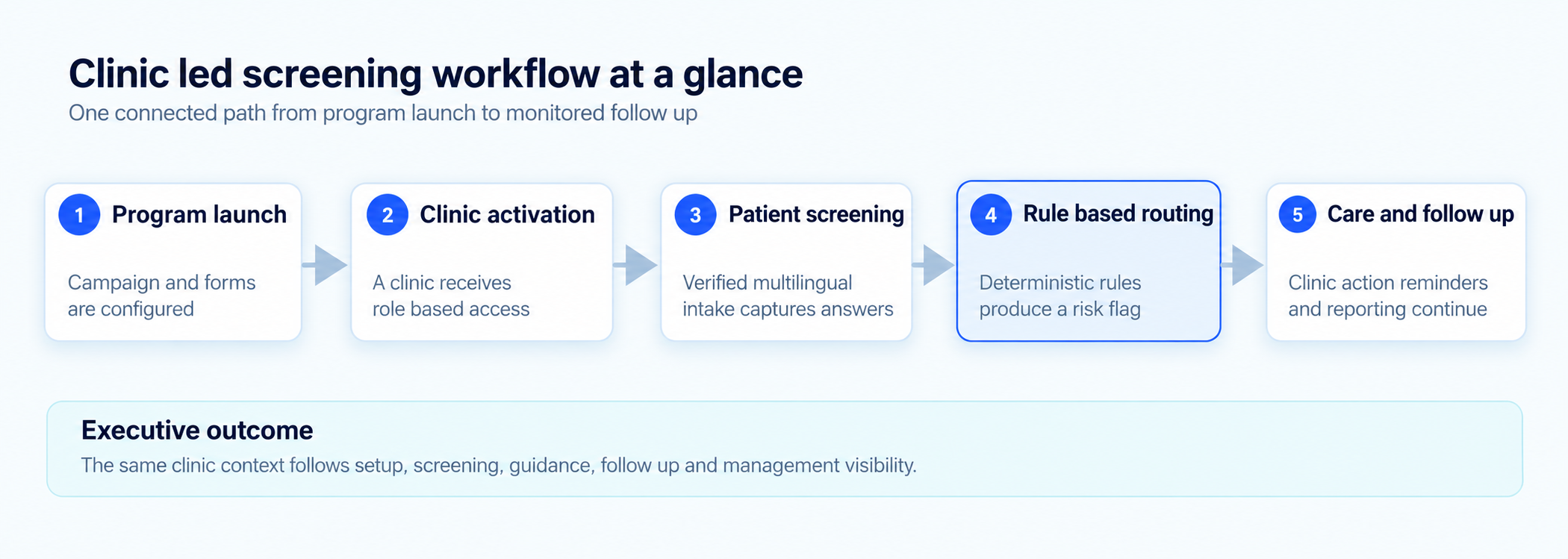
Executive conclusion The implementation creates a shared execution record across teams while keeping patient classification deterministic and clinical decisions human-owned.
BUSINESS WORKFLOW AND OPERATING PROBLEM
The business workflow
A program team configures a campaign and its screening services. Field representatives activate eligible clinics. Doctors control clinic access and staff roles. Patients verify the clinic, accept terms, choose a language and complete a screening. The application routes the result to an immediate next action, while clinic teams own follow-up and managers monitor execution.
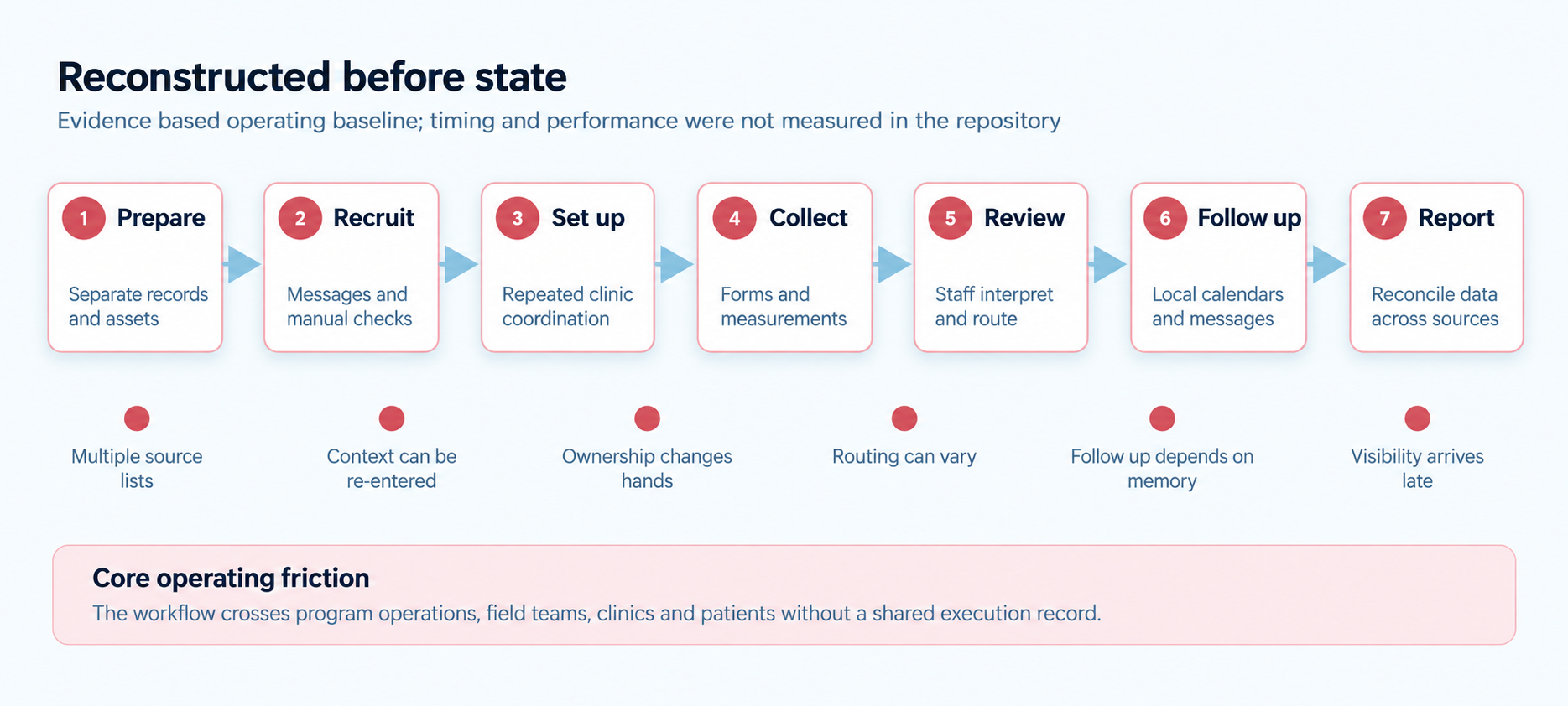
The problem with the traditional workflow
Fragmented execution
Program, field, clinic and patient context can sit in separate records or messages.
Eligibility and duplicate checks rely on accurate handoffs.
Clinic setup and asset distribution require repeated coordination.
Delayed control
Screening review can vary without a shared rule set.
Follow-ups depend on local calendars or individual memory.
Managers reconcile sources before they can intervene.
Evidence note This before-state is a reconstruction from implemented controls and operating documentation. It is not a measured historical baseline.
REDESIGNED OPERATING MODEL
The redesigned workflow
The application carries the operating context forward. Role and clinic access are validated, the correct localized form is presented, explicit answer mappings produce a severity category, records and reports are created, and due follow-ups surface for clinic action. People remain accountable for inputs, interpretation, communication and care.
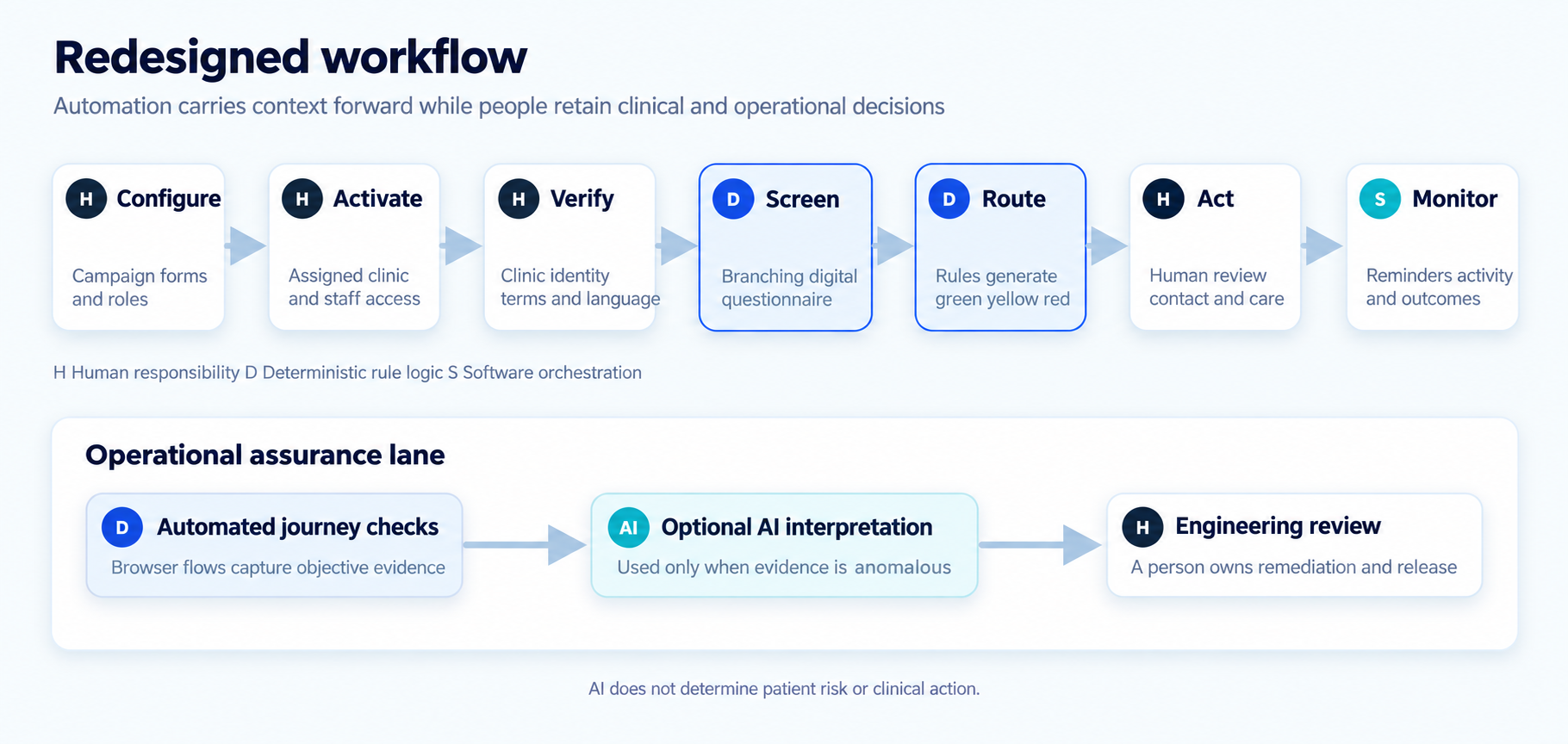
What the application does
CONFIGURE AND ACTIVATE
Defines programs, forms, approved clinics, role access and service assets.
GUIDE INTAKE
Verifies clinic context, records terms and presents localized branching questions.
ROUTE CONSISTENTLY
Uses form-specific deterministic mappings to generate green, yellow or red guidance.
COORDINATE AND MONITOR
Creates records, reports, activity signals, reminders and exception evidence.
AI boundary Optional AI may interpret anomalous automated-test evidence. It does not determine patient risk or care.
APPLICATION FLOW AND CONTROLS
How the application works
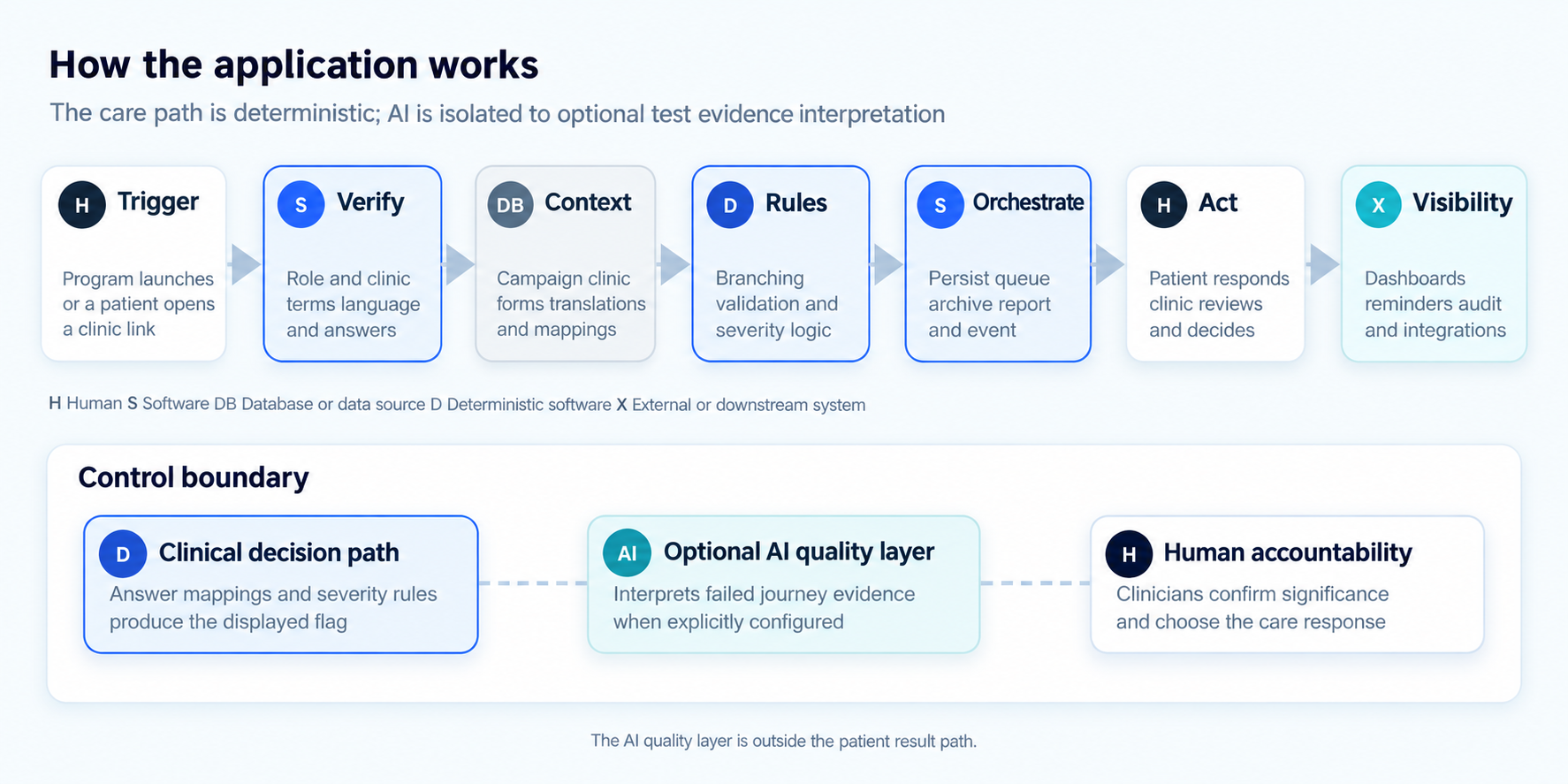
INPUTS AND PROCESSING
Campaign settings, clinic identity, localized forms, patient answers and growth measurements enter validation, branching and severity rules.
ORCHESTRATION AND ACTIONS
A valid submission creates a pseudonymous patient key, stores flags, builds the result and queues reports, archives and trend work.
HUMAN CONTROL
Patients supply information; staff review reminders; clinicians confirm significance and decide care; managers interpret operating indicators.
OUTPUTS AND VISIBILITY
Patients receive guidance and clinic contact actions. Operators receive reports, due-date queues, activity, certification and exception status.
Resilience Background work supports retry and audit status so downstream processing need not hold the patient response open.
EVIDENCE CONTROLLED BUSINESS VALUE
What changed
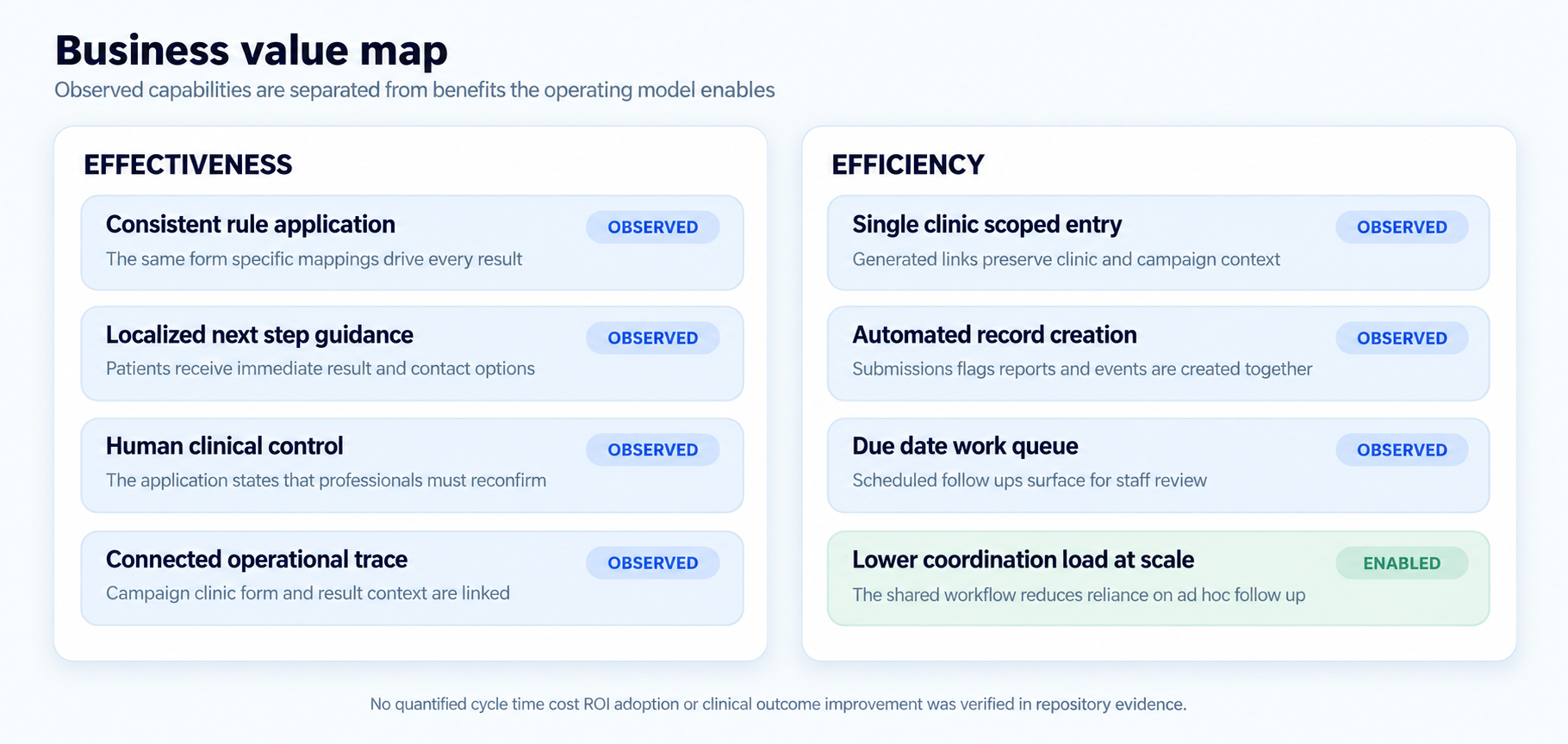
Effectiveness
Form-specific rules support consistent risk routing.
Localized guidance links each result to a practical next action.
Role separation and audit records strengthen operational control.
Clinicians remain accountable for interpretation and care.
Efficiency
Context travels through one clinic-scoped workflow.
Records, results, reports and activity signals are created together.
Due follow-ups appear in a date-based work queue.
The model enables less manual reconciliation at scale.
Observed Capabilities directly demonstrated in code and operating flows. Enabled Benefits the design structurally supports without a measured outcome study.
Measured business outcomes None verified. No time, cost, ROI, adoption, accuracy, revenue or clinical-outcome improvement is claimed.
TRANSFERABLE WORKFLOW DESIGN
A reusable operating pattern
The same pattern applies wherever a distributed program must activate local providers, collect structured information, apply consistent rules, preserve expert judgment, coordinate follow-up and give managers current visibility. Comparable settings include multi-site services, regulated onboarding, inspection programs, field operations and distributed professional services.
What can be reused
Program-scoped workflow and shared context across roles
Approved-universe onboarding and generated access assets
Multilingual intake with conditional questions and deterministic rules
Human-review checkpoints for high-consequence decisions
Background work, retry, audit and exception patterns
Operational dashboards and automated journey evidence
What must be customized
Business and clinical rules
Terminology and role permissions
Approval authorities and escalation guidance
Data sources and external integrations
Metrics, retention and communication policy
Interface and regulatory controls
Human responsibility
Software can validate, route, record, queue and monitor. Patients remain responsible for the information they provide. Clinic staff review outbound communication. Qualified professionals confirm clinical significance and choose the care response. Authorized leaders own program decisions, exceptions and sensitive data actions.
What this case demonstrates
The application creates value by redesigning the complete operating workflow around a shared execution record. Software handles repeatable validation, routing, recording and monitoring. AI is limited to a bounded quality-assurance role. People remain responsible where context, clinical expertise, communication or risk control matters.
Publication note Confidential names, domains, identifiers and operating volumes have been removed. The reconstructed baseline and any future quantified outcomes require owner approval before external use.
Anonymized executive case study
Page