EXECUTIVE WORKFLOW TRANSFORMATION
From Manual Checks to
Continuous User Journey Assurance
AN ANONYMIZED WORKFLOW TRANSFORMATION CASE STUDY
A growing technology-enabled organization redesigned how it verifies critical digital journeys, routes exceptions, and keeps management informed. Distributed execution now feeds one controlled operating record while people retain authority over investigation and closure.
BUSINESS CHALLENGE
Assurance depended on coordination
Critical journeys crossed systems, data and credentials. Manual checks, evidence collection and owner follow-up delayed a complete view of risk.
OBJECTIVE
Make every check accountable
Create a repeatable process that captures what happened, routes exceptions quickly and preserves responsibility from detection to resolution.
SOLUTION
A purpose-built assurance platform
Distributed nodes execute approved journeys. The central application validates events, structures incidents, routes alerts and maintains the operating history.
VALUE CREATED
One closed operating loop
Shared visibility, consistent lifecycle states, automatic incident routing and human control at the decisions that manage risk.
THE OPERATING PROBLEM
The Business Workflow
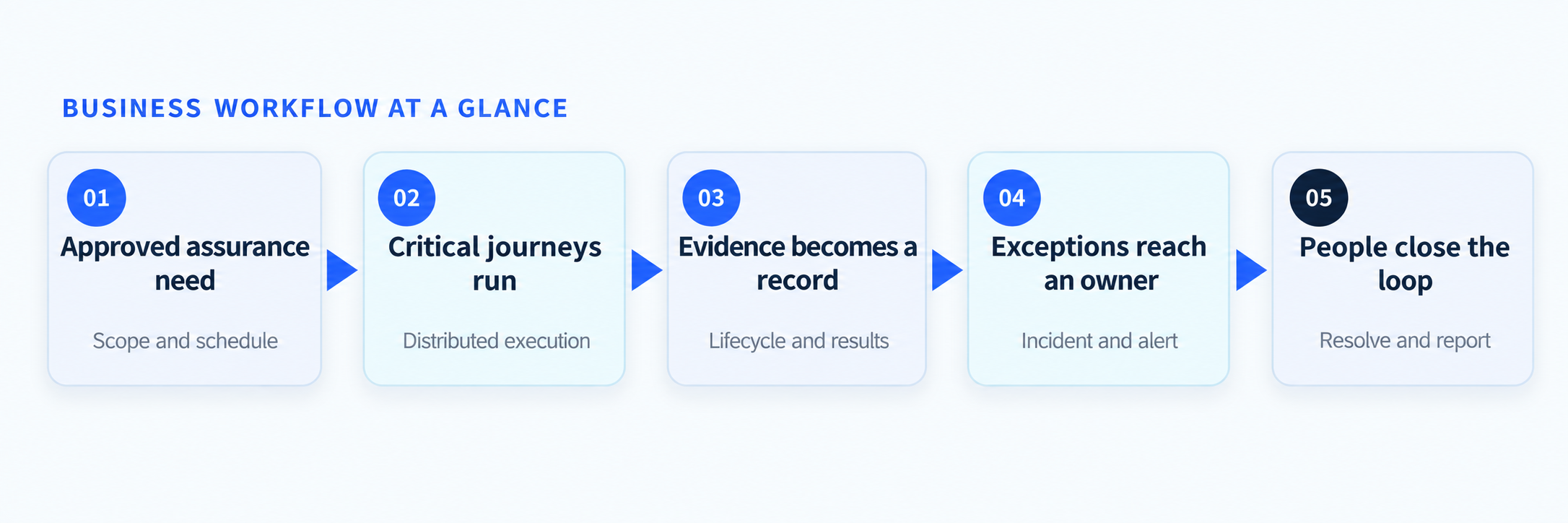
A recurring assurance need becomes an operational result only when execution, evidence, ownership and closure remain connected.
An approved schedule or operator starts a critical user-journey check. An execution node confirms readiness, performs the journey and captures its steps and evidence. If the journey fails, the organization must understand what happened, decide who owns the response, investigate, close or accept the exception, and communicate the result to management.
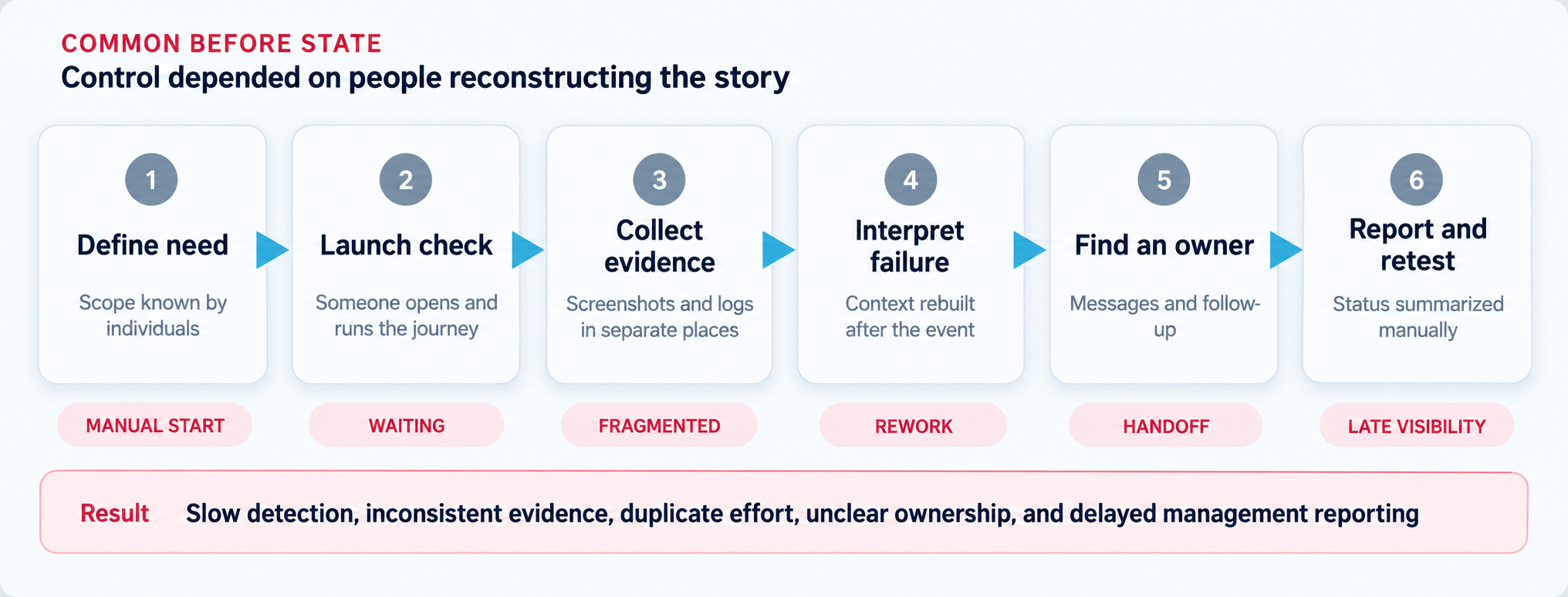
Where Friction Accumulates
MANUAL CONTROL
Coverage depends on individuals
People must know what to run, when to run it and which conditions matter.
FRAGMENTED EVIDENCE
The operating story is incomplete
Readiness, status, screenshots, traces and logs can sit in different places.
LATE INTERPRETATION
Context is rebuilt after failure
Teams reconstruct the failed step, expected result and likely cause after the event.
UNCLEAR HANDOFF
Ownership travels through messages
Assignment, acknowledgement and resolution depend on repeated follow-up.
DUPLICATE EFFORT
Related faults start parallel work
Without a stable incident fingerprint, similar reports can be investigated twice.
MANAGEMENT DELAY
Reporting follows the work
Leaders receive summaries after coordination instead of a live operating view.
Evidence basis The complete historical baseline was not documented. This before state reflects the common control gaps that the implemented application replaces.
THE IMPROVED OPERATING MODEL
The Redesigned Workflow
The new process separates distributed execution from central oversight and joins detection, evidence, ownership and reporting in one loop.
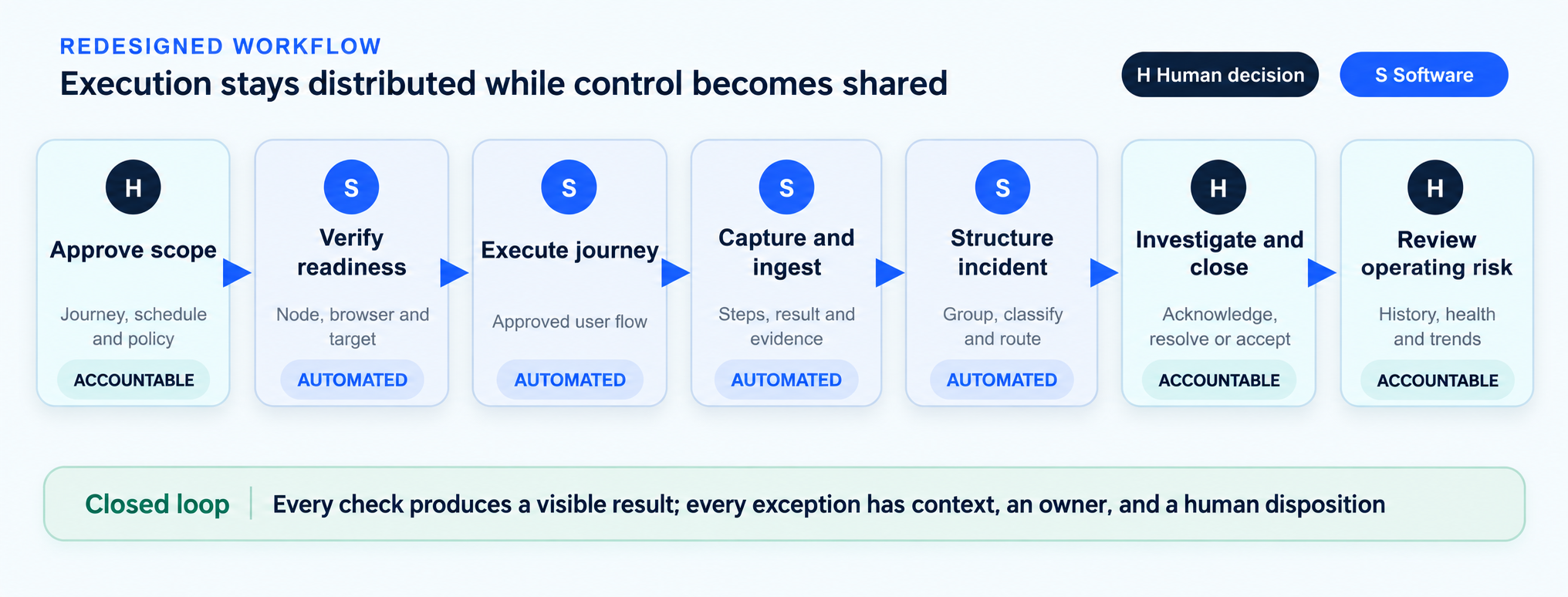
Execution nodes own browser readiness, journey execution, local evidence and delivery retry. The central application owns the registry, event history, current status, incident record, notification state and management view. This division lets each system execute locally while the organization manages assurance consistently.
What the Application Does
01 Registers coverage
Accepts the current systems, services and journey inventory from each execution node.
02 Tracks readiness
Keeps current and historical health for the node, browser tooling and active work.
03 Builds the run record
Stores ordered lifecycle events and projects the latest run and step status.
04 Structures exceptions
Connects the fault to evidence, expected and actual behavior, step, owner and fix guidance.
05 Routes attention
Creates an unread notification and a tracked alert for configured operators.
06 Supports closure
Records acknowledgement, investigation, resolution, exception acceptance, reopening and notes.
MANAGEMENT VISIBILITY
Run history, lifecycle timelines, execution-node health, service health, recent success and failure rates, duration, open incidents and resolution state are available in one operating view.
THE APPLICATION CONTROL LOOP
How the Application Works
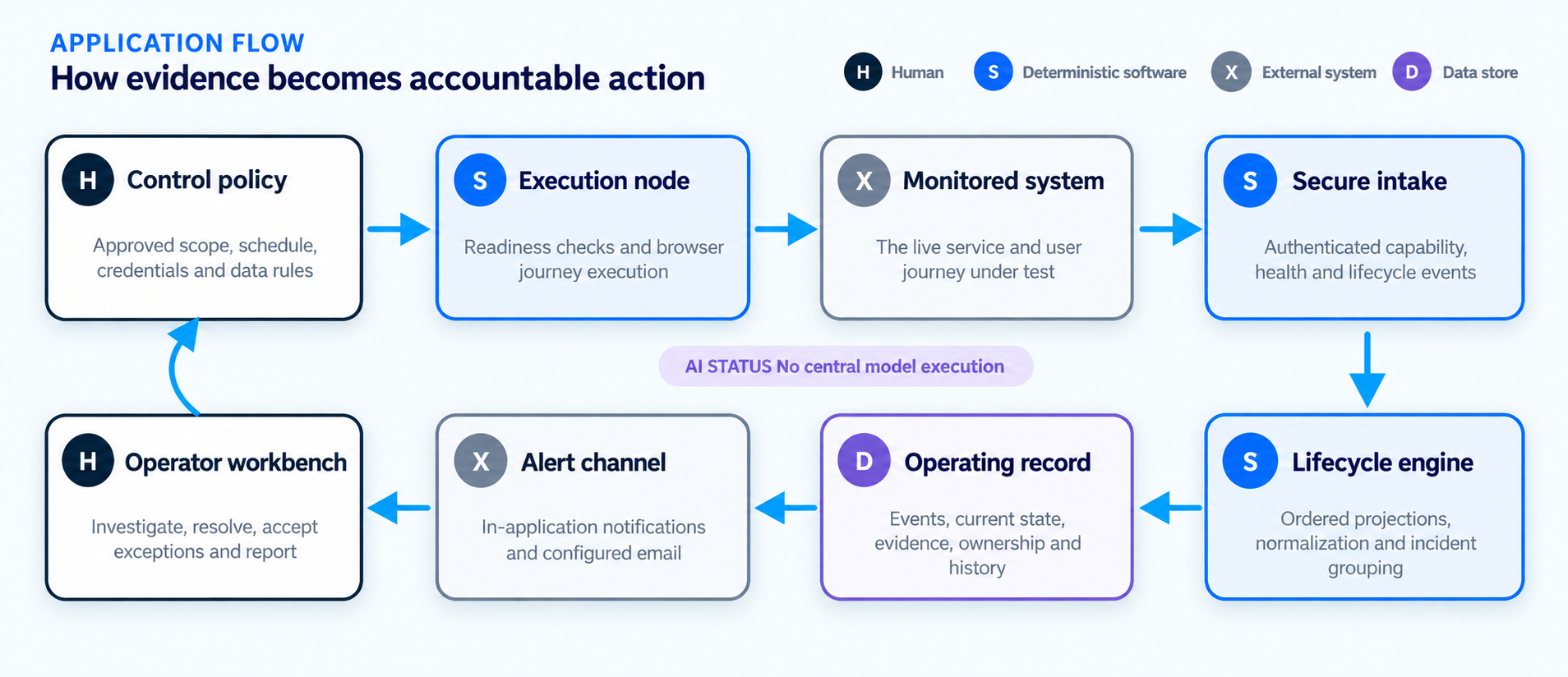
The central platform coordinates evidence and response. It does not execute the monitored journeys or replace operator judgment.
INPUTS
Coverage and execution evidence
Inventory, health, run and step events, errors, evidence metadata, results and standalone service faults.
PROCESSING
Deterministic state control
Authentication, duplicate protection, ordering, projection, normalization, grouping and occurrence counts.
ORCHESTRATION
Push-based coordination
Execution nodes send events outward; the central platform never polls a node or starts its browser run.
ACTIONS
Incidents and alerts
Creates incidents, evidence links, notifications, alert records, histories and operating metrics.
HUMAN CONTROL
People own risk decisions
Scope, schedules, data policy, investigation, remediation, exception acceptance and closure stay human.
VISIBILITY
Current state plus history
Fast operating projections sit beside the retained lifecycle record and resolution trail.
ARTIFICIAL INTELLIGENCE
No AI model runs in the central application. Supplied plain-language summaries can be displayed, and deterministic helpers translate selected technical patterns. AI does not approve, classify or close incidents.
EVIDENCE-BACKED VALUE
What Changed
The strongest demonstrated gains are better control quality, consistency and visibility. Enabled operating outcomes still require measurement.
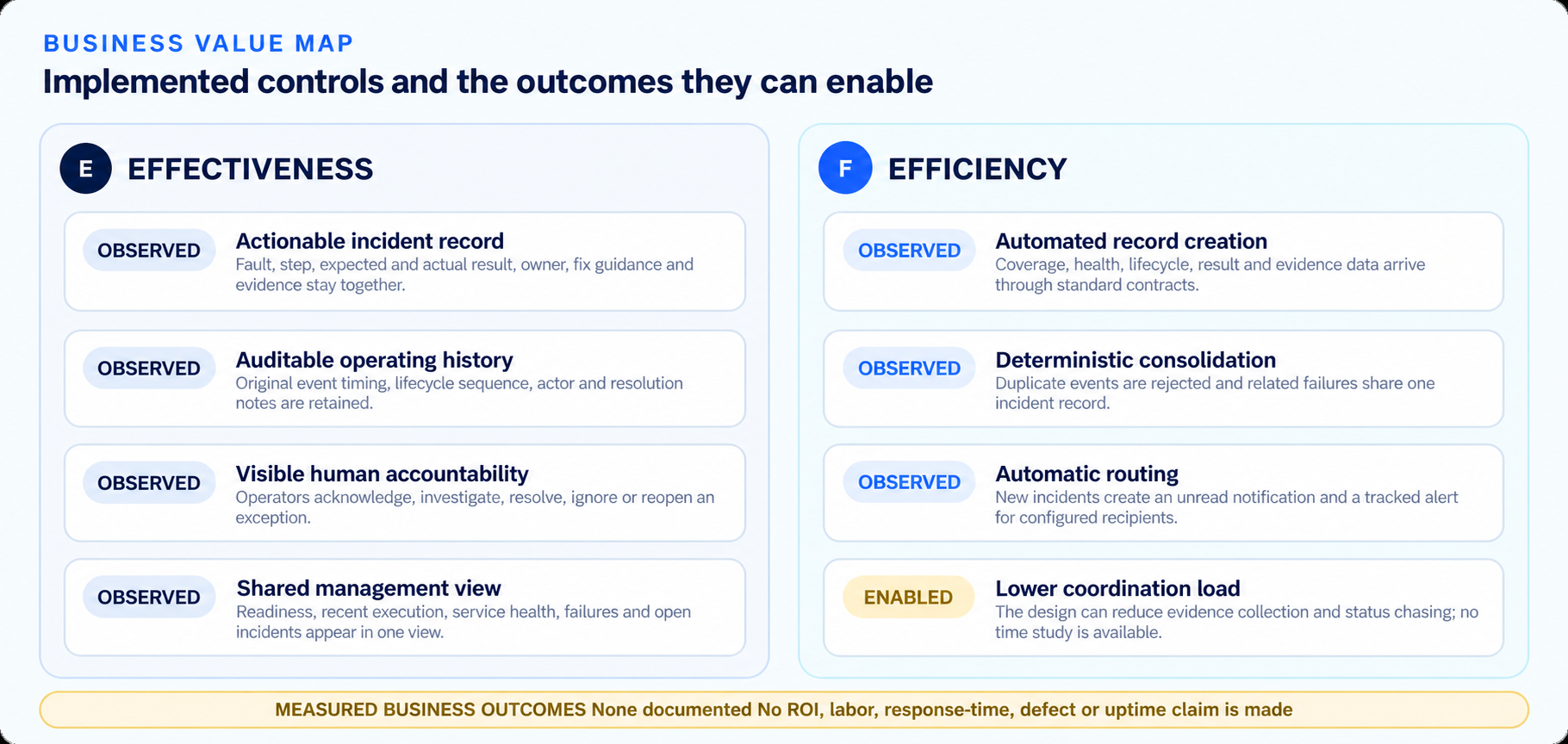
Benefit Evidence
MEASURED
No quantified operating outcome
No time study, ROI analysis, cost comparison, response-time trend, defect reduction or uptime improvement was found.
OBSERVED
Controls implemented in software
The repository directly demonstrates event ingestion, incidents, evidence, routing, operator actions and dashboard visibility.
ENABLED
Outcomes that need validation
Less evidence collection, fewer status chases and easier scaling follow logically from the design but remain unmeasured.
Control and Risk
PEOPLE REMAIN ACCOUNTABLE
Leaders approve scope and policy. Operators interpret evidence, coordinate remediation, record resolution, accept justified exceptions and reopen issues when new evidence appears.
TRANSFERABLE DESIGN
A Reusable Operating Pattern
The workflow applies wherever digital services must be checked repeatedly across teams or environments and where failures need accountable closure.
COMMON PATTERN
Approve the control scope > execute close to the system > capture evidence > classify and route exceptions > preserve human resolution > report the operating result
APPLICABLE ORGANIZATIONS
Where the pattern fits
Growing organizations with multiple digital services, distributed teams, frequent releases, complex handoffs or rising coordination costs.
APPLICABLE FUNCTIONS
Who uses the result
Operations, engineering, product management, customer support, compliance and executive management.
REUSABLE SOFTWARE PATTERN
What transfers
Standard event contracts, distributed execution, central history, current-state projection, incident grouping, evidence control and notifications.
MANAGEMENT PATTERN
What leaders gain
One view across systems and environments, with explicit ownership, status, evidence and resolution history.
Customization Required
- Critical journeys, execution frequency and production-safety rules
- System inventory, integrations, credentials, data and evidence-retention policy
- Severity, ownership, alert recipients, escalation path and resolution authority
- Management metrics, compliance requirements and approved AI use, if any
What This Case Demonstrates
WORKFLOW TRANSFORMATION
The value came from redesigning the complete assurance process. Execution moved close to each system; a purpose-built application standardized evidence and exception handling; deterministic automation removed repetitive coordination; and people retained authority over scope, remediation and risk. The result is a reusable control pattern for continuous assurance with human accountability.
Evidence boundary No quantified business outcome is claimed. Before-state details, production adoption and role ownership should be confirmed before external publication.
ANONYMIZED WORKFLOW TRANSFORMATION CASE STUDY
PAGE