EXECUTIVE WORKFLOW TRANSFORMATION
From Case Files to
Legal Analysis and Drafts
An anonymized workflow-transformation case study
An application for legal matter preparation in India
Business challenge
Preparing a legal matter means turning instructions, documents and disputed facts into a position a lawyer can defend. Evidence gaps and uncertain legal support must remain visible as the work moves from research to strategy and drafting.
Objective
Create one connected preparation workflow that carries evidence and qualifications forward, makes unfinished work visible and preserves the lawyer's authority over the result.
Solution
A purpose-built application organizes the case record, coordinates legal research and source checks, develops strategy, tests opposing arguments and prepares a structured work bundle. Ordinary software controls sequence, records and release conditions. AI contributes document understanding and substantive analysis within defined tasks. Lawyers review facts, resolve uncertainties and decide how the work is used.
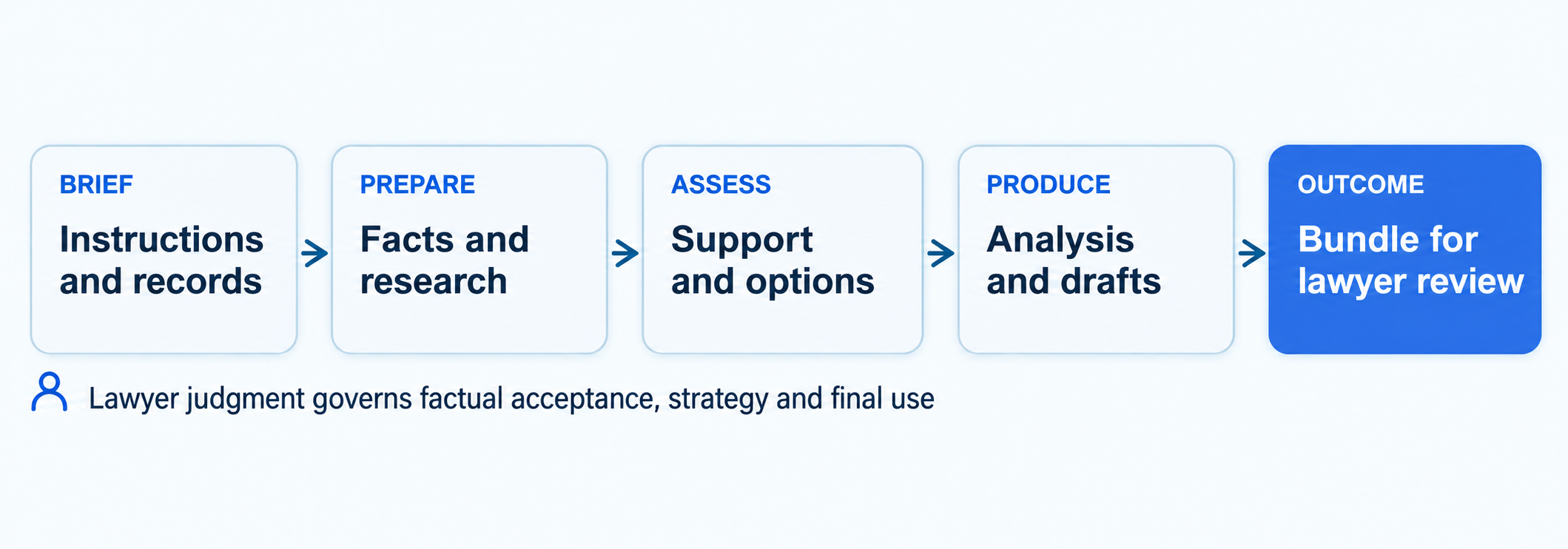
Business workflow at a glance
Value created
- A shared factual record links analysis back to supplied documents.
- Research checks distinguish captured sources from supported legal propositions.
- Review points and release blockers identify the next action.
- Document assembly and reuse of current work automate repetitive preparation.
Evidence lens. These are implemented capabilities. The available synthetic example shows partial execution through source retrieval; downstream drafting and delivery are supported by code and test cases, not a completed live outcome in that example. No measured business savings are claimed.
The business workflow
The process starts when a lawyer receives a brief and supporting records for a matter. The lawyer defines the question and desired result; the application operator registers the matter and its documents. One person may perform both roles.
Preparation then requires a chronology, a reliable account of the facts, relevant law, a proposed course of action and documents for review. Information moves between the supplied record, legal sources and the people responsible for analysis and drafting. The final handoff is a coherent work bundle that the lawyer can assess before advising, communicating or filing.
The problem with the traditional workflow
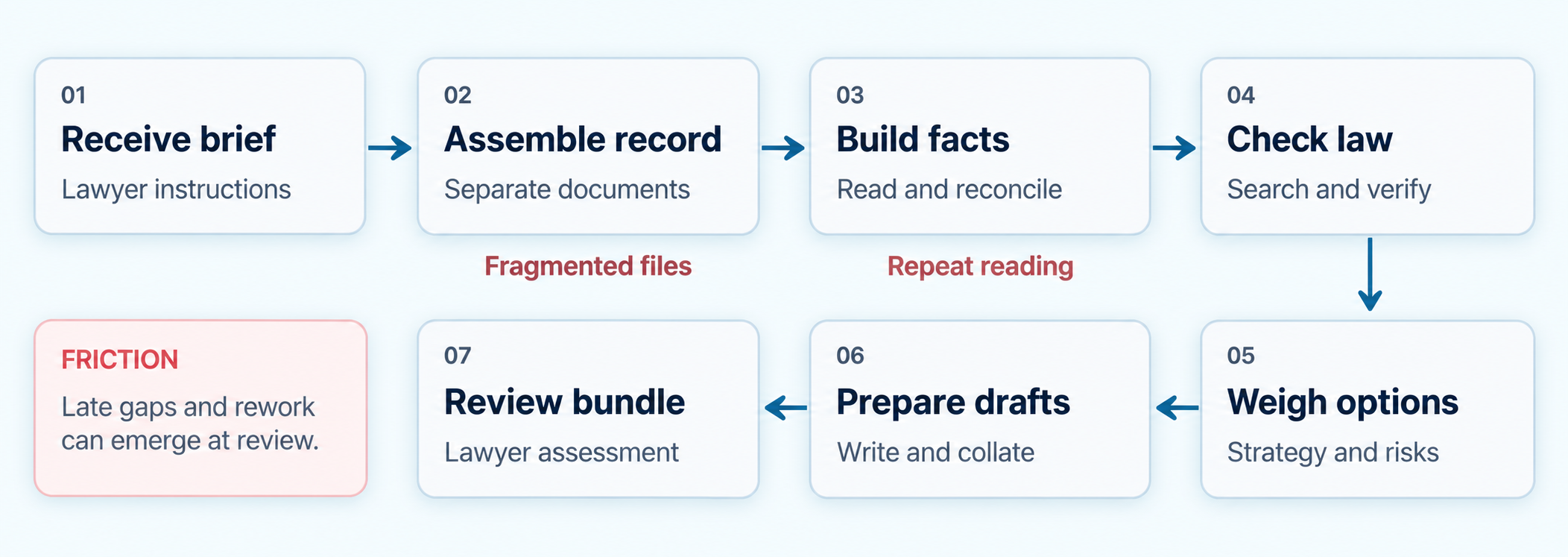
The following before-state is a reasonable reconstruction from the application's design. A documented historical process and its performance baseline were not available.
Inferred friction | Why it matters to the business |
|---|---|
Repeated reading and consolidation | Facts and dates may have to be rebuilt for each work product. |
Separate source checks | Finding a judgment does not settle whether it supports the proposed argument. |
Gaps discovered late | Missing proof can undermine a strategy after drafting has begun. |
Manual assembly and reconciliation | Research, arguments and drafts must remain consistent as the record changes. |
Status held in individual work files | A reviewer has to reconstruct what is complete and what still needs attention. |
Why scaling is difficult. Each additional matter adds documents, authorities and decisions to reconcile. When their relationships are maintained through individual effort, coordination grows alongside substantive legal work. The application addresses those relationships explicitly; the size of any resulting saving remains unmeasured.
The redesigned workflow
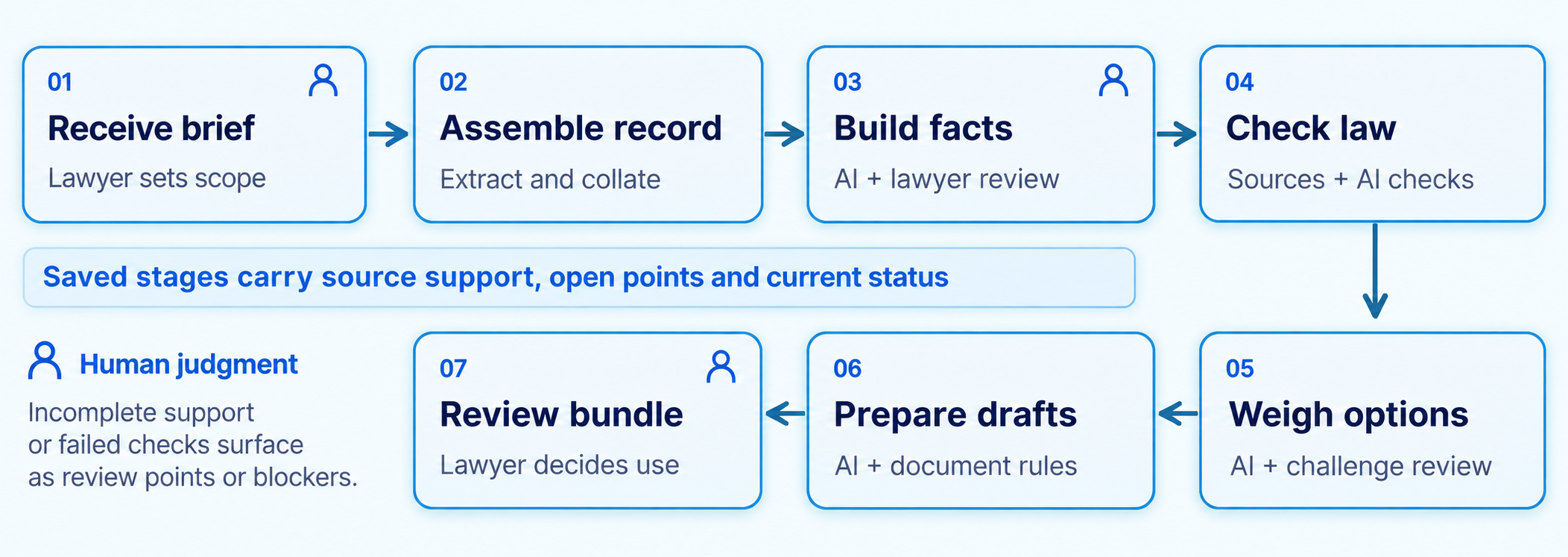
The application turns preparation into a sequence of saved stages. Documents are extracted and consolidated before focused recovery of materially unclear content. A factual record and chronology inform initial research. Selected authorities then undergo source and substantive review before strategy, challenge review and drafting.
The responsible lawyer can review factual entries and resolve conflicts. An operator advances the saved stages through checkpoints. The same matter record supplies later work, while unresolved issues retain their consequences instead of disappearing into a summary.
What the application does
Business capability | What it changes in the workflow |
|---|---|
Organizes the record | Consolidates material facts, source references, conflicting accounts and document gaps. |
Scopes and checks the research | Selects material authorities, retrieves sources and distinguishes discovery from verified support. |
Develops and challenges the position | Produces strategy and a separate review of opposition arguments, risks and missing prerequisites. |
Prepares consistent work product | Creates selected drafts and assembles research, analysis and review points into a current bundle. |
Makes exceptions actionable | Shows factual, legal and document-readiness blockers with their required next actions. |
When something changes. Changes to factual evidence or review decisions invalidate affected downstream work. Current, unaffected material may be reused through the application's defined controls. This supports coherent revision without treating earlier conclusions as permanently valid.
How the application works
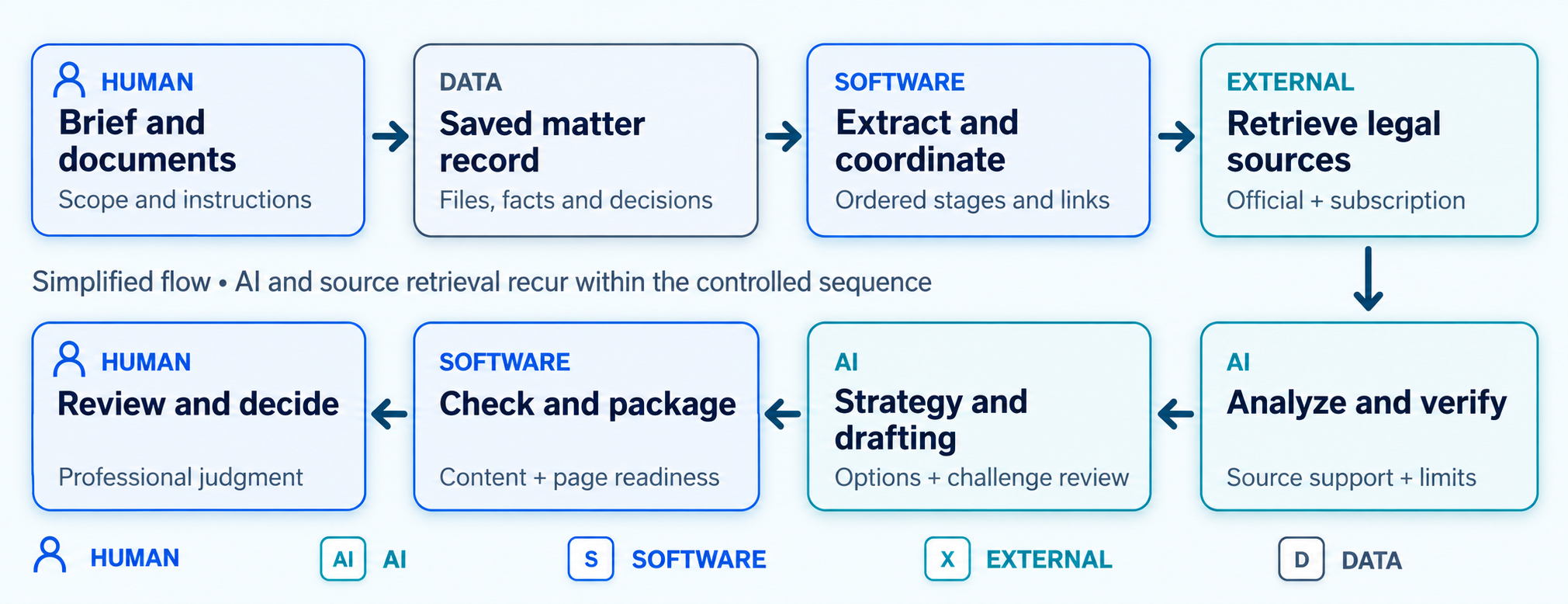
The application connects document preparation, legal sources and the review workspace around one saved matter record. Its business role is to control what each stage receives, what it produces and whether the next step has the support it needs.
Element | Business role |
|---|---|
Inputs | Lawyer instructions, matter details, supporting documents and factual review decisions. |
Processing | Extract text, prevent duplicate file intake, link evidence and maintain the current record. |
AI | Organize facts, assess document quality and legal support, synthesize research, develop and challenge strategy, and prepare draft content. |
Orchestration | Save work item by item, validate stage order and resume from the appropriate current checkpoint. |
Actions and outputs | Retrieve sources, create structured analysis and editable documents, render pages for review, and assemble a downloadable bundle when required checks pass. |
Human control | Review facts and conflicts, assess legal conclusions, choose the course of action and authorize final use. |
Visibility | Matter progress, pending factual reviews, missing proof, source checks, draft restrictions and document readiness. |
Retrieval and judgment have distinct roles. Ordinary software retrieves complete statutes and exact-identifier judgments from official and subscription sources. Browser recovery handles documents that the standard routes could not capture. AI performs substantive reading and support analysis; obtaining a document alone does not verify its legal proposition.
Exceptions reach the review workspace. Unavailable or mismatched sources become unresolved checks. Missing proof can restrict a proposed route to working-draft status. Stale content or blocking document defects prevent the current bundle download. Automated document review is separate from a lawyer's professional approval.
What changed
The implemented change is a connected preparation process with explicit evidence and readiness controls. Its business value has two dimensions: helping reviewers assess the work more consistently, and reducing preparation that must otherwise be repeated or coordinated manually.
Business value map
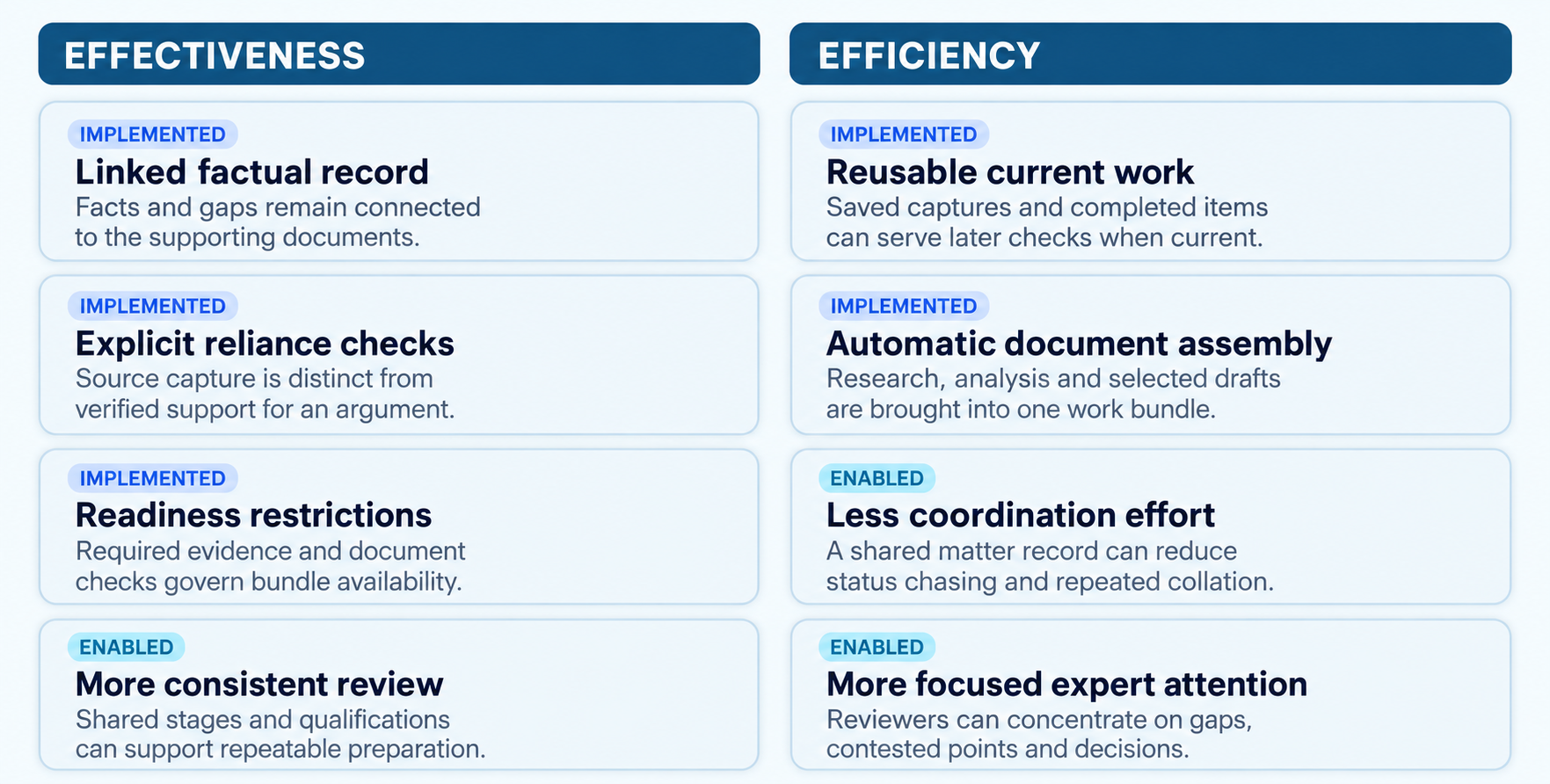
Implemented means the capability is directly represented in the application. Enabled means a plausible operating benefit that still needs measurement in use.
How value should be assessed
The material reviewed does not establish a before-and-after improvement in lawyer time, cycle time, cost, error rate or legal outcomes. A synthetic execution snapshot records workflow activity and unresolved work; it is not a productivity study. Likewise, test cases demonstrate intended checks, not adoption or production reliability.
A practical evaluation would compare similar matters on reviewer time, total preparation time, rework caused by missing evidence and the proportion of work returned with unresolved support. It should also check whether lawyers find the source links and review points useful. These are proposed measures, not reported results.
Human control remains central. The application prepares and checks work for the lawyer. The lawyer remains responsible for accepting facts, assessing authority, choosing strategy and approving advice, communication or filing.
A reusable operating pattern
This case concerns legal matter preparation, but its underlying operating problem occurs wherever professionals must turn an uneven evidence base into a defensible recommendation and a formal deliverable. The transferable pattern is to carry source support and unresolved questions through every stage of the work.
Where the pattern fits
The closest applications are law firms, specialist legal practices and in-house legal teams handling document-heavy matters. Professional-services, compliance and investigation teams may also find the design relevant when their work requires source-backed findings, challenge review and expert approval. Those are possible adaptations, not deployments demonstrated by this case.
Reusable design | Customization required |
|---|---|
One structured evidence record | Document types, data fields, source references and terminology. |
Bounded analysis and challenge stages | Professional standards, reasoning tasks, jurisdiction and review questions. |
Explicit support and readiness checks | Business rules, evidence thresholds and conditions for issuing the deliverable. |
Visible exceptions and human decisions | Reviewer roles, approval authority and escalation procedures. |
Controlled source access and output assembly | Integrations, access rights, document templates and retention requirements. |
Conditions for useful reuse
A suitable workflow has recurring stages, accessible evidence and a clear expert decision at the end. Its owner must define what counts as sufficient support, who resolves exceptions and when changed evidence requires regeneration. Local pilots should establish whether the controls improve reviewer effectiveness and reduce preparation effort.
This implementation provides current-state visibility rather than a permanent version history. Organizations needing immutable records or different retention duties would need to adapt that design. Source availability, permitted access and the firm's final release procedure also shape deployment.
What this case demonstrates
Purpose-built software can connect evidence intake, research, professional reasoning and document preparation around a single matter. AI contributes analysis within that process; ordinary software preserves sequence, dependencies and release conditions. The result is a preparation workflow in which source support and unresolved decisions remain visible to the lawyer. Its broader value lies in making expert work easier to inspect and coordinate while preserving responsibility for the final judgment.
ANONYMIZED CASE STUDY / LEGAL MATTER PREPARATION